
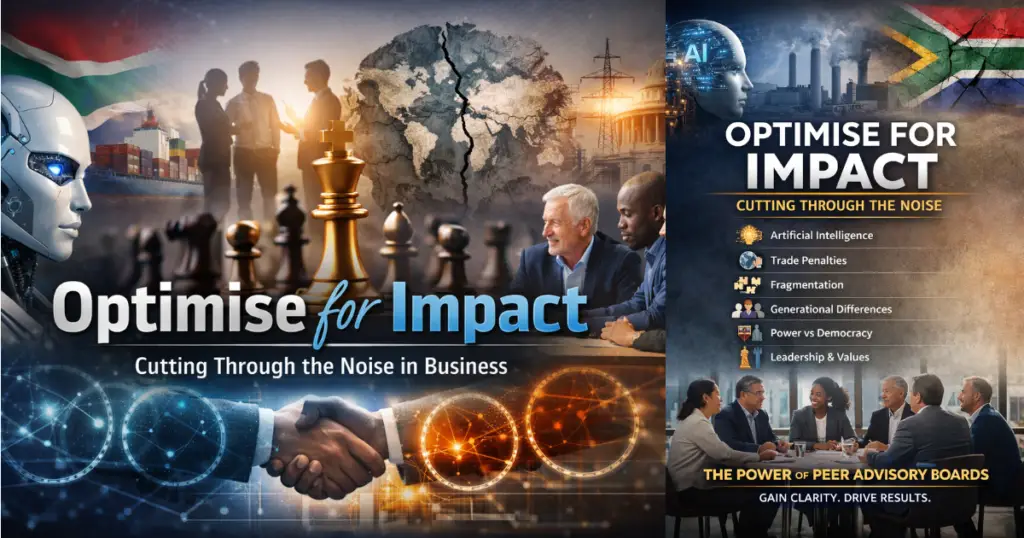
Optimise for Impact
There has probably never been a time in the history of your business that has seen more noise than the past 18 months.
Artificial intelligence dominates headlines and boardroom conversations alike. Trade penalties, tariffs, and geopolitical shifts reshape supply chains overnight. Societies feel less united, not necessarily more divisive, but increasingly fragmented. Generational differences in the workforce create tension around expectations, loyalty, and purpose. Power, democracy, values, leadership – all debated loudly, often emotionally, and usually without clear resolution.
For Business Owners and Leaders, this noise is not theoretical. It shows up every day in decision fatigue, competing priorities, and a constant sense that whatever you focus on, something equally important is being neglected.
The real question is not what is happening in the world. The question is: How do you optimise for impact when everything feels urgent, loud, and complex?
The Cost of Noise in Leadership
Noise is not just external. It creeps into businesses through:
- Conflicting information and advice
- Rapidly changing trends that promise quick wins
- Pressure from employees, customers, suppliers, shareholders, and regulators
- A fear of being left behind if the “next big thing” is ignored
The result is often reactive leadership. Strategy becomes a series of short-term responses rather than a coherent long-term direction. Leaders find themselves busy, but not always effective.
In South Africa, this challenge is amplified. Businesses operate in an environment shaped by energy and water uncertainty, regulatory complexity, economic pressure, and social transformation. The margin for error is small, and the consequences of poor prioritisation are significant.
Optimising for impact, therefore, is not about doing more. It is about seeing clearly enough to do the right things, consistently, over time.
Why Focus Has Become a Competitive Advantage
In an era of overload, focus is no longer a soft skill – it is a strategic advantage.
Organisations that outperform their peers tend to share a few common traits:
- Business Owners and Leaders have a clear North Star
- They are clear on what truly drives value in their business
- They resist the temptation to chase every trend
- They align leadership teams around a small number of critical priorities
- They make better decisions, not faster decisions
Focus allows leaders to distinguish between what is interesting and what is important. It creates alignment. It builds momentum. Most importantly, it enables impact.
But clarity rarely happens in isolation.
The Myth of the Lone Decision-Maker
Many Business Owners and Leaders still carry the unspoken belief that leadership means having the answers. That strength equals certainty. That asking for perspective is a sign of weakness.
In reality, some of the most impactful leaders are those who deliberately surround themselves with challenge, diversity of thought, and real-world perspective.
Complex environments require more than individual brilliance. They require collective intelligence.
No matter how experienced you are, your view is shaped by your industry, your history, your assumptions, the people you surround yourself with and your blind spots. When noise increases, those blind spots become more dangerous.
This is where trusted peer advisory boards come into their own.
The Power of Trusted Peer Advisory Boards
A trusted peer advisory board is not a networking group, a social forum, or a casual discussion circle. At its best, it is a structured environment where business leaders:
- Engage with peers who understand the weight of leadership
- Share real challenges in a confidential setting
- Test assumptions against diverse perspectives
- Separate signal from noise through disciplined dialogue
The value lies not in advice alone, but in quality thinking.
Peers from different industries bring pattern recognition without competition. They ask questions you may avoid. They challenge narratives you have grown comfortable with. They hold up a mirror to your decisions, your leadership style, and your strategic direction.
In a noisy world, this kind of environment creates clarity.
Seeing Through the Noise Together
Consider some of the dominant themes leaders are grappling with right now:
Leadership and Values
Values, your North Star, are easy to state and hard to live. Trusted peers help leaders translate values into behaviours, decisions, and trade-offs – especially when the pressure is on.
These conversations are richer, more honest, and more actionable when they happen with people who have nothing to sell, nothing to gain, and everything to contribute.
Fragmentation and Uncertainty
When social and political narratives feel unstable, leaders benefit from grounded conversations that focus on what can be controlled: culture, values, ethical leadership, and long-term resilience.
Generational Differences
Rather than framing this as conflict, peer groups help leaders understand underlying drivers – values, communication styles, and expectations – and design leadership responses that work across generations.
Artificial Intelligence
AI is neither a silver bullet nor a threat to be feared blindly. In peer advisory discussions, leaders move beyond hype to ask: Where does AI genuinely improve productivity, decision-making, or customer experience in our context?
From Insight to Impact
Clarity without action is just another form of noise.
What differentiates high-performing leaders is their ability to turn insight into disciplined execution. Peer advisory boards support this by:
- Helping leaders prioritise what matters most
- Stress-testing strategic decisions before implementation
- Creating accountability through shared commitment
- Encouraging long-term thinking in a short-term world
Over time, this compounds. Better decisions lead to stronger organisations. Stronger organisations create more resilient economies and communities.
Optimising for Impact as a Leader
To optimise for impact in today’s environment, leaders need to ask themselves:
- What deserves my attention right now – and what does not?
- Which decisions will matter in five years, not just five months?
- Where might my own assumptions be limiting my perspective?
- Who do I trust to challenge my thinking constructively?
The answers rarely come from headlines or social media feeds. They emerge from thoughtful, structured conversations with people who understand the responsibility of leadership.
The South African Context
South African business leaders operate under unique pressures, but also unique opportunities. Mid-sized businesses are agile enough to adapt, yet established enough to shape markets, create employment, and influence communities.
Optimising for impact here means leading with intention. It means resisting cynicism, embracing complexity, and committing to continuous improvement – not in isolation, but together.
A Call to Action
If the past 18 months have taught us anything, it is that clarity is not a luxury. It is a necessity.
If you are a Business Owner or Leader who wants to see through the noise, sharpen your focus, and optimise for real impact, consider the value of engaging with a trusted peer advisory board.
The right environment does not give you answers. It helps you ask better questions – and make better decisions.
Impact is not accidental. It is designed.
#peeradvisoryboards
#peeradvisoryboards
#tabboards
#tabboardssa
#thealternativeboard
#thealternativeboardsa