
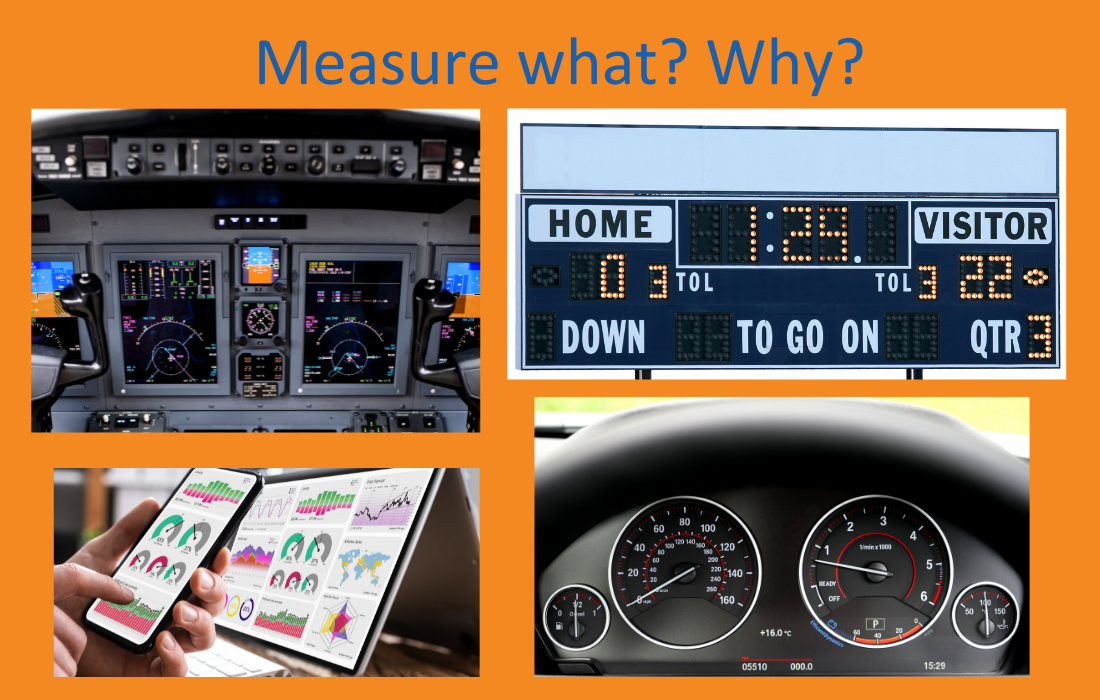
Death and Taxes – we joke that these are the only certainties in life. But we often hear and read about how “uncertainty of policy” is not good for business and investor confidence. Case in point, the invasion of Ukraine by Russia. Markets reacted immediately due to the uncertainty – what will now happen, how long will it last, what will be the impact on oil prices, input costs, inflation, interest rates, etc.
How do Business Owners and Leaders create certainty in their own worlds, within the greater world? The answer? By using a Dashboard, using information sourced from Measurement.
Some years ago, I had to have surgery on one of my shoulders due to an old injury. I mention old because it took some years for the original injury to get to that point where forced intervention was required.
Intervention was required because it had gotten to a point where I had difficulty using my arm for certain movements. Up until that point I had compensated – I did some things differently, or not at all, and other things I did incorrectly that in turn caused other physical challenges – injuries to my neck and back.
Eventually, I visited my GP. After a few injections, physio, and a biokineticist later, I ended up in the room of an orthopedic surgeon with a set of x-rays. The surgeon looked at the x-rays, shared with me that he had a good idea of what was wrong, and told me to have an MRI done. This would allow him to see where the exact issue is and give him more certainty before making a diagnosis.
Only upon my return with the MRI did the surgeon have enough information to make an informed diagnosis. From his Dashboard – X-rays and MRI – he could now see what needed to be done.
I was ecstatically happy and satisfied that he did not go only on my word, my experience, but had equipped himself with more information before he decided to diagnose.
We use Dashboards daily for many things – we just don’t think about it, we do it subconsciously.
How would you feel if you had to get into your car, or onto an airplane, and you see no Dashboard? Will you drive or fly, not knowing important vitals like level of fuel, traveling speed, and engine oil levels?
How would you feel if the airplane you were in had to land without the guidance of air traffic controllers, and their Dashboards?
How would you feel if you had to inflate the tyres of your car or an airplane to a pressure you could not measure?
Would you go scuba diving without a divers watch, not being able to see how deep you are? Or without an air meter on your scuba tank, not being able to see how much air you have available?
Imagine a sport – think ice hockey, soccer, or cricket, without a scoreboard to inform players and spectators of what the state of the game is.
Even at single-person sports events, like cycling, and running, it is important to know how far I’ve come, and how far I must go.
Smart watches tell us our heartbeat, blood pressure and steps as well as incoming messages, for example calls and email.
Notifications on our mobile phones and laptop screens tell us of received messages, and the battery levels.
In the absence of a Dashboard, we don’t see the “injuries” and its impact. We start compensating and are blind to what the impact of that compensation is on the other areas of the business. And before we know it, years have gone by and now we are forced to act. We are at a point of forced intervention. Chaos…?
A Dashboard or scoreboard keeps us informed of what happened to date, what is going on right now. It is the summary of the Measurement, the current results, the status quo.
Measurement allows us to get information required to make informed diagnostics before we do any fixing. Measurement does not only take people’s word for what is going on. Measurement takes emotions out of decision-making; it works with facts.
Measurement through Dashboards helps to implement much more accurate and targeted actions.
Without Measurement and Dashboards, we “fly blind,” hoping for the best, relying on past experiences, letting emotions play a role, believing that “it will all work out.”
At the world’s busiest airport, Atlanta Hartsfield-Jackson International Airport[1], 58 air traffic controllers handle 2 600 landings and take-offs every day, in all kinds of weather conditions, relying on their Dashboards, and the Dashboards of the pilots of those airplanes, for all to come together.
How many decisions do you as a Business Owner and Leader make on a daily, weekly monthly basis? What do you use to guide you?
[1] https://www.businessinsider.com/what-it-takes-air-traffic-controller-at-worlds-busiest-airport-2020-11?IR=T