
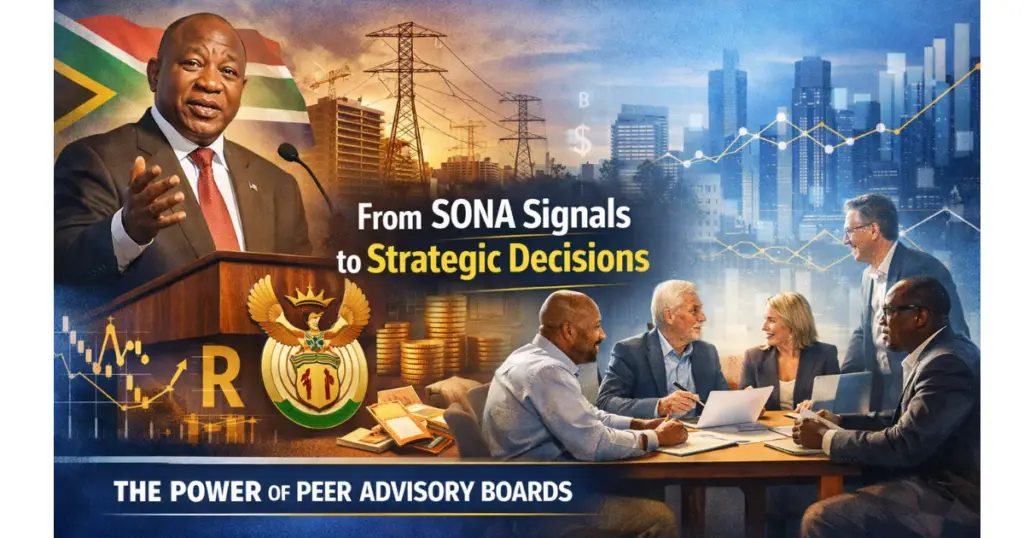

SONA 2026: Strategy, Signals and the Power of the Right Room
This week, like many South African Business Owners and Leaders, you probably listened to and read about the State of the Nation Address.
You listened and read for signals.
For direction.
For risk.
For opportunity.
And maybe, just maybe, you asked yourself a deeper question: What does this actually mean for my business – now and over the next three to five years?
Because that’s the real issue.
SONA is not meant to be political theatre. It is supposed to be a strategic data point. It is supposed to shape regulation, infrastructure priorities, fiscal pressure, labour dynamics, energy and water stability, and investor confidence. Whether you like what you heard or not is irrelevant.
The real question is: How do you interpret it? And who helps you interpret it well?
The Short-Term Impact: Noise or Navigation?
Immediately after SONA, commentary flooded every channel.
Economists. Analysts. Journalists. Political commentators. Industry bodies.
Everyone has a take.
But as a Business Owner and Leader you don’t have the luxury of intellectual debate for its own sake. You want clarity. You want perspective. You want decision-quality thinking.
In the short term, SONA influences:
- Market sentiment
- Currency volatility
- Regulatory enforcement posture
- Government spending timelines
- Infrastructure project momentum
- Energy policy direction
- Tax enforcement intensity
These factors directly affect your –
- Pricing strategy
- Cash flow planning
- Capital expenditure timing
- Hiring decisions
- Risk tolerance.
But here’s the uncomfortable truth: Most business owners process SONA in isolation.
They sit with their executive team, interpret through their own bias, and move on.
That is dangerous.
Why?
Because your internal team shares your worldview. They operate inside your culture. They often hesitate to challenge your assumptions robustly. And when national policy signals are ambiguous – as they often are – blind spots multiply.
In volatile environments, isolation amplifies risk…
The Longer-Term Impact: Reading the Trajectory
SONA is rarely about immediate change. It is about trajectory.
Are we seeing a signal toward:
- Increased state intervention?
- Public-private partnership acceleration?
- Energy reform realism?
- Labour policy rigidity or flexibility?
- Infrastructure prioritisation that opens sector opportunity?
- Tax base expansion pressure?
Strategic leaders do not react to headlines. They interpret patterns.
If you are building a business with a future horison, you must ask:
- What structural shifts are emerging?
- What industries are being quietly favoured?
- Where will compliance become tighter?
- Where will opportunity compound?
- How will this affect access to capital?
- How will it shape talent availability?
These are not questions to answer casually.
They require perspective beyond your industry echo chamber.
The Leadership Isolation Trap
- The part few people talk about openly:
- Running a business in South Africa can be lonely.
- Your staff look to you for certainty.
- Your customers expect stability.
- Your suppliers expect confidence.
- You expect growth.
But who challenges your thinking?
Who pressure-tests your assumptions?
Who asks you the hard questions after SONA?
Who tells you where you might be misreading the signals?
Your accountant sees numbers.
Your attorney sees legal risk.
Your banker sees exposure.
Your consultants see projects.
But very few see you – the decision-maker navigating complexity.
And very few will disagree with you in a meaningful way.
That is where many leaders unknowingly limit themselves.
The Strategic Advantage of Trusted Peer Advisory Boards
The most resilient leaders do something different. They don’t process national events alone.
They sit in rooms – structured, confidential, disciplined rooms – with other Business Owners and Leaders who are facing similar macro realities but from different industries and perspectives.
Trusted peer advisory boards create a strategic advantage in five critical ways:
1. Cross-Industry Pattern Recognition
When SONA speaks about infrastructure, energy reform, public procurement, or business support, different industries feel it differently.
In a peer advisory environment, you hear:
- How manufacturing interprets the signal
- How logistics sees the operational impact
- How professional services anticipate compliance shifts
- How retail anticipates consumer sentiment shifts
Patterns emerge faster.
Blind spots shrink.
You begin to see the broader chessboard, not just your square.
2. Objective Challenge Without Agenda
Unlike suppliers or advisors with commercial interests, peer advisory board members have no agenda.
Their only interest is robust thinking and mutual growth.
That means they ask:
- “Are you overreacting or underreacting?”
- “Are you underestimating or overestimating the risk?”
- “What assumption are you making that might be wrong?”
- “What assumption are you not making?”
- “How would this decision look if interest rates stay at these levels for longer?”
- “What if energy stability improves faster than expected?”
That kind of disciplined challenge changes the quality of your decisions.
3. Emotional Calibration in Uncertain Times
SONA often triggers emotional responses – optimism, scepticism, frustration, fatigue.
Emotion influences strategic judgment more than we admit.
In a trusted advisory environment, leaders recalibrate. They test emotional reactions against reality.
Instead of reacting to headlines, they respond with structure.
That emotional maturity compounds over time.
4. Accountability to Think Long-Term
It is easy to slip into defensive short-termism.
Delay expansion.
Pause hiring.
Cut investment.
Hoard cash.
Sometimes that is prudent. Sometimes it is fear disguised as prudence.
Peer advisory boards force leaders to articulate their longer-term strategy clearly – and defend it.
That discipline protects against reactive drift.
5. Strategic Courage
In every uncertain environment, opportunity hides.
Government infrastructure commitments can unlock supplier ecosystems.
Energy reform can unlock production expansion.
Regulatory tightening can eliminate weaker competitors.
Policy clarity can attract investment partnerships.
But opportunity favours prepared leaders.
Courage is easier when your thinking has been pressure-tested.
The South African Context: Complexity Requires Community
Let’s be honest. Doing business in South Africa is not simple.
We navigate:
- Electricity challenges
- Growing water challenges
- Policy uncertainty
- Infrastructure backlogs
- Currency volatility
- Skills shortages
- Regulatory shifts
- Global geopolitical shocks
And yet – South African businesses are remarkably resilient.
The difference between those who merely survive and those who scale is not intelligence.
It is not capital alone.
It is not even opportunity.
It is the quality of decision-making.
And decision quality improves dramatically when leaders think in community rather than isolation.
After SONA: Three Questions Every Leader Should Be Asking
As you reflect on the latest address, consider these:
- What assumptions about the economy am I carrying into 2026 that may need updating?
- Where might opportunity exist if government execution improves?
- Who is helping me test my interpretation rigorously?
If your answer to the third question is vague, that is a strategic vulnerability.
Thought Leadership Is Not About Commentary
Thought leadership is not tweeting opinions about SONA.
It is not forwarding articles on WhatsApp groups.
It is about structured, disciplined, collaborative thinking that produces better outcomes.
It is about being proactive rather than reactive.
It is about surrounding yourself with people who elevate your perspective.
The strongest leaders we see are not the loudest.
They are the most deliberate.
They invest in the quality of the room they sit in.
The Power of the Right Room
Strategy is shaped in rooms. The room you choose matters.
Is it reactive?
Is it compliant?
Is it transactional?
Is it comfortable?
Or is it rigorous, honest, forward-looking and growth-oriented?
In a country where policy signals can shift the landscape quickly, you cannot afford to interpret the future alone.
The leaders who will thrive over the next decade are those who:
- Share insights generously.
- Challenge each other respectfully.
- Think long-term consistently.
- Hold one another accountable.
- And interpret national signals collectively.
A Call to Action
If SONA has prompted reflection about your strategy, your risk exposure, or your growth ambition – don’t let that reflection fade into routine.
Ask yourself:
Are you making your biggest decisions in isolation?
If you are a Business Owner or Leader and you are serious about elevating the quality of your thinking, it may be time to sit in a different kind of room.
A room of trusted peers.
A room where your assumptions are tested.
A room where strategic clarity compounds.
Explore how a trusted peer advisory board can strengthen your leadership and sharpen your strategy in uncertain times.
The future will not reward isolated decision-making. It will reward deliberate, collaborative intelligence.
#peeradvisoryboards
#SONA
#tabboards
#thealternativeboard
#peeradvisoryboardssa
#SONA2026
#tabboardssa
#thealternativeboardsa