

“Man Up” Is Killing Them
What the Stats Actually Show About Men, Silence, and the Boardroom Nobody Built
June is Men’s Mental Health Month. Somewhere around the country, there will be a webinar, a LinkedIn graphic, and a well-meaning poster in an office kitchen. None of that is wrong. But none of it touches the actual problem, which is this: South African men are dying by suicide at a rate that should be front-page news every single week, and most businesses run by men have built absolutely nothing to catch them before they fall.
Let’s start with the numbers, because the numbers are not subtle.
The Stats Nobody Wants on a Coffee Mug
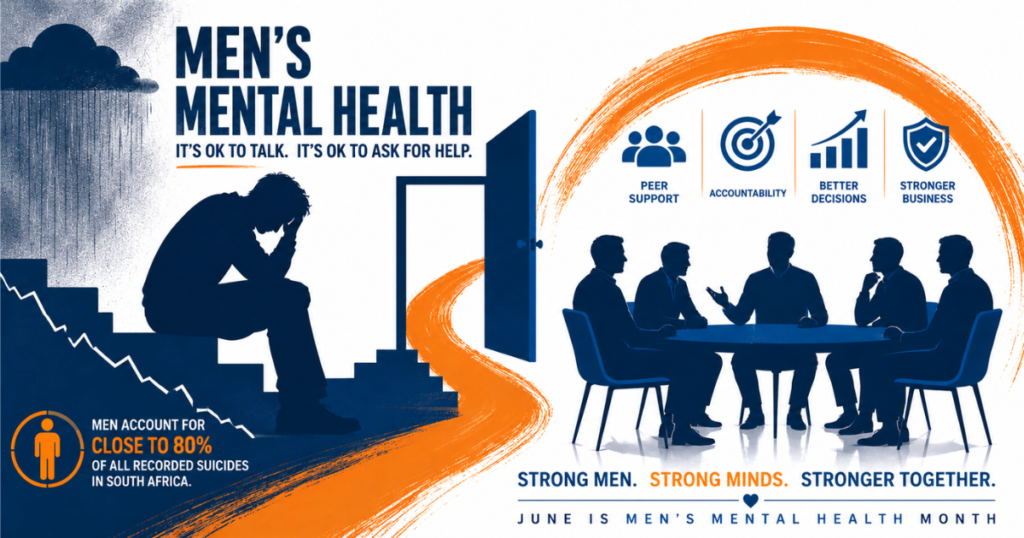
Men account for close to 80% of all recorded suicides in South Africa. That figure was confirmed in Parliament this year by the Minister in the Presidency for Women, Youth and Persons with Disabilities, who described the situation as a “silent national emergency”. South Africa’s overall suicide rate sits at roughly 23.5 deaths per 100 000 people, which places the country among the highest in the world for this particular, preventable cause of death. The South African Depression and Anxiety Group (SADAG) estimates that there are around 23 reported suicides a day in this country, and 230 serious attempts. SADAG’s helplines now take up to 3 000 calls a day, and the organisation spends upward of R110 000 to R150 000 a month just keeping the phone lines open, with no government funding to help carry that cost.
Read that again. A non-profit is personally bankrolling the country’s only suicide crisis line because the demand will not stop growing.
The reasons aren’t mysterious. Unemployment, financial pressure, family breakdown, substance abuse, and unresolved trauma are named again and again by researchers and government alike as the drivers. What’s also named, consistently, is stigma. SADAG and the SA Federation for Mental Health both describe a pattern where men are socialised from childhood to suppress distress rather than express it, so instead of showing sadness, they show anger, withdrawal, or risk-taking, which is exactly the kind of behaviour that gets mistaken for “just how he is” rather than a warning sign.
“We must break the stigma that says men must suffer quietly.” – Minister Sindisiwe Chikunga, May 2026
Now Make It a Business Owner
Here’s where this stops being a general health story and becomes a business story. If you are a Business Owner or Leader reading this, you already carry a heavier-than-average load of exactly the stressors that the research links to male mental health strain: financial pressure, isolation, and the unspoken expectation that you are the one who is supposed to have it together.
South Africa’s own data on entrepreneurs backs this up directly. Old Mutual’s 2025 Entrepreneur Health and Wellbeing Survey, the first study of its kind in the country, found Business Owners working under extreme emotional and financial strain, with deep isolation cited as a recurring theme, particularly among those excluded from formal business networks. A separate global Founder’s Report, covering entrepreneurs across 46 countries, found that 87.7% had struggled with at least one mental health issue, with roughly half reporting high anxiety and just under half reporting high stress. Locally, researchers and accelerator programmes such as Property Point have named the same four recurring issues for South African entrepreneurs: stress and a lack of self-care, doubt and uncertainty, social isolation, and shame around admitting any of it.
Social isolation is the one worth sitting with. Running a business is, by design, a position with no peer group built in. You have staff who report to you, clients who need things from you, and a bank manager who wants answers, but very rarely do you have someone in the room who has actually carried the exact weight you’re carrying, with no agenda except to ask you the hard question and stay until you answer it properly.
That gap doesn’t show up on a balance sheet. It shows up in 2am decision fatigue, in snapping at people who didn’t deserve it, in the quiet conviction that admitting you’re struggling is the same as admitting you’ve failed. For men in particular, that conviction is reinforced by exactly the cultural conditioning the research keeps flagging: be the rock, don’t burden anyone, man up.
“Man Up” Was Never a Strategy
“Man up” tells a man to absorb pressure alone and call it strength. It is not strategy, it is suppression with a slogan attached, and the suicide statistics in this country are the clearest possible evidence of what suppression actually costs.
The uncomfortable truth for Business Owners specifically is that the very traits that built your business, self-reliance, decisiveness, a refusal to show weakness in front of the team, are the same traits that keep you from getting support before a problem becomes a crisis. You built a business by trusting your own judgement. At some point, that same instinct starts working against you, because nobody who is only ever right is also being challenged, and nobody who is never challenged is getting an honest read on their own blind spots, financial or psychological.
What a Peer Advisory Board Actually Does About This
This is precisely the gap a Peer Advisory Board (PAB) is built to close, and it’s worth being specific about how, rather than waving vaguely at “support”.
- It puts you in a room, monthly, with other Business Owners and Leaders who are carrying comparable weight, not as a therapy group, but as a working board that holds you accountable to your own goals and challenges your thinking before a bad decision becomes an expensive one.
- It replaces isolation with structure. You are no longer the only person who has seen the real numbers, the real staff problems, or the real doubt. Someone else in that room has been there, and will say so, directly, without the politeness a junior staff member might feel obliged to use.
- It normalises asking for help before there’s a crisis, because the entire model is built around regularly admitting what isn’t working. That single shift, doing this routinely rather than only in an emergency, is the opposite of the stigma the mental health research keeps identifying as the core problem.
- It pairs peer accountability with one-to-one coaching and a structured planning tool, the Blueprint, so the support isn’t just emotional venting, it’s tied directly to clearer decisions and a business that runs better because its owner is thinking straighter.
None of this is marketed as a mental health intervention, and it shouldn’t be, because that’s not what it is. But the mechanism is the same one researchers point to as protective: regular, structured, honest connection with people who understand your exact pressures, replacing silence with a standing appointment where silence isn’t an option.
The data on what this does for the business side is just as direct. TAB members report a 2.5x revenue growth rate over the national average, 68% report increased turnover since joining a board, and 87% report improved leadership skills. Better decisions and a clearer head tend to travel together. That isn’t a coincidence; it’s the entire point of putting structured peer challenge around a job that, for most owners, has none.
The Real Question for June
Awareness months are useful for one thing: they create a moment to ask a question you’d otherwise keep avoiding. So here’s the question, stripped of any soft framing: if you, as a Business Owner or Leader, went quiet for two weeks, who in your business or your life would actually notice, ask why, and expect a straight answer back?
If the honest answer is “no one, really,” that is not a personal failing. It’s a structural one. Most owner-managed businesses in South Africa, by design, have no board, no formal peer check, and no one whose job includes asking you the hard question. A Peer Advisory Board is one practical way to build that structure back in, before the cost of not having it shows up somewhere far more serious than a missed quarterly target.
South Africa loses roughly 23 men and women a day to suicide, and the overwhelming majority of them are men. That is not a statistic to post about and move past. It’s a number that should change how seriously business owners take the idea of sitting in a room, regularly, with people who will ask how you’re actually doing, and wait for the real answer.
This article addresses suicide and mental health statistics. If you or someone you know is struggling, SADAG operates a free, 24-hour helpline. Visit www.sadag.org or call 0800 567 567 for the Suicide Crisis Line.
#Leadership #Coaching #BusinessBuildersAdvantage #TheAlternativeBoard #PeerAdvisoryBoards