
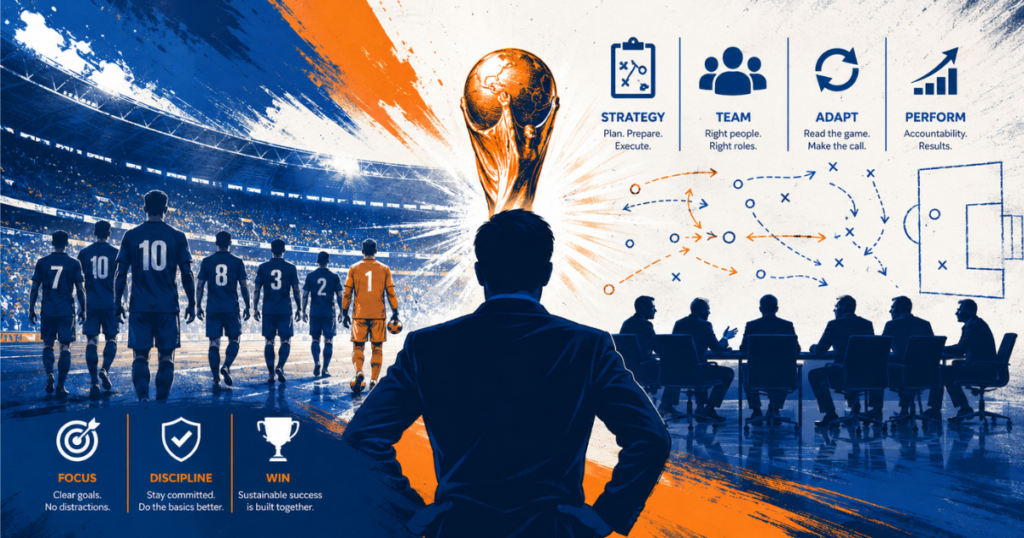

The Beautiful Game of Business: What the 2026 World Cup Teaches Business Owners and Leaders About Winning
The pitch and the boardroom have more in common than you think – and most business owners are playing without a team.
The 2026 FIFA World Cup is in full swing. As of this week, the Round of 32 knockout stage has kicked off across the United States, Canada, and Mexico – 48 nations, 104 matches, and a global audience of billions watching to see who survives long enough to lift that golden trophy on 19 July at MetLife Stadium in New Jersey.
South Africa made it to the tournament. Bafana Bafana. That alone was reason enough to stop what you were doing and watch. And while the result in the group stage was a bittersweet exit, the campaign reminded every South African what happens when a group of individuals – diverse in background, different in skill sets, but united in purpose – commit to a common goal and a shared game plan.
Now here is the question worth sitting with: how does your business compare?
Because if you strip away the grass, the boots, and the noise of the crowd, what you are watching every single night of this World Cup is a masterclass in the exact skills that separate thriving businesses from ones that are slowly running out of time.
Here is what the game is actually teaching you.
1. The Game Plan: Strategy Is Not Optional
Before a single ball is kicked, every World Cup coaching team spends months building a strategy. Not a vague intention – a real, documented, pressure-tested game plan. Who plays where. What formation works against which opponent. Where the vulnerabilities are. What the contingencies look like when things fall apart by the 30th minute.
The best coaches at this tournament – Didier Deschamps with France, Pep Guardiola disciples running modern pressing systems, the tacticians reshaping how African football is played – are not improvising. They are executing a strategy that has been stress-tested, debated, and refined long before kickoff.
Most Business Owners, if they are honest, cannot say the same. They have a general sense of where they want to go. They have targets. But a strategy – a written, challenged, peer-reviewed strategic plan with clear priorities, KPIs, and a contingency built in for when the market shifts? That is a different conversation.
The TAB Blueprint – the strategic planning tool available to every TAB Peer Advisory Board member – exists precisely for this reason. It forces you to commit your vision, your SWOT analysis, your goals, and your execution priorities to paper, and then it holds you to them. Month after month. With your peers watching.
No great team has ever won a World Cup by winging it. Neither has a great business.
2. Know Your Role: The Danger of the One-Man Team
Watch any elite football match and you will see something worth noting. The goalkeeper does not chase the striker. The striker does not drop back to defend set pieces. The left back knows his lane, his responsibility, and his limits. Each player on the pitch is doing their specific job – with excellence – so that the whole machine functions.
When one player tries to do everything, teams fall apart. In business, this happens every day.
The Business Owner who is the salesperson, the finance director, the HR department, the operations manager, and the strategic planner all at once is not building a business. They are building a very stressful job. And they are almost certainly doing most of those roles at a level that a specialist could do better.
One of the most consistent themes that surfaces in TAB Peer Advisory Board meetings is this: Business Owners discover – sometimes painfully – that the areas they are weakest in are precisely the areas they avoid delegating. It takes a peer who is not inside your business to see that blind spot clearly. Someone who can say, directly, “You are playing goalkeeper and striker at the same time, and you are going to blow both.”
The best World Cup teams win because everyone owns their role. The best businesses grow when their leaders learn to do the same.
It takes a peer who is not inside your business to see your blind spots clearly.
3. Adapt or Go Home: Real-Time Intelligence Changes Everything
This World Cup has had more than its share of moments where the game plan changed mid-match. Injuries. Red cards. A team that comes out in the second half with a completely different shape. Tactical substitutions that shift momentum in twelve minutes.
The coaches who win are the ones who adapt without panicking. They have done the preparation. They know their players. They have options ready. And critically – they have a group of people around them providing real-time intelligence: assistant coaches, analysts, physiotherapists, opposition specialists. Nobody running a professional football team at this level makes major decisions alone.
And yet, that is exactly how the majority of Business Owners run their companies. Alone. Surrounded by staff who report to them but cannot challenge them. Possibly with a spouse who is tired of hearing about cash flow. Maybe with an accountant or an attorney who gives transactional advice when asked. But nobody who pulls up a chair, looks at the full picture, and says: “Here is what I think you are missing. Here is what I would do differently.”
That is what a TAB Peer Advisory Board is. It is your coaching staff. No more than eight Business Owners from non-competing sectors, meeting monthly, professionally facilitated, in a confidential environment. People who have been in similar battles. Who understand the pressure of making payroll. Who have navigated staff crises, market shifts, and economic body blows – and who will tell you what they genuinely think, not what you want to hear.
TAB has been running these boards since 1990. Across 27 countries. With more than 25 000 businesses helped. Globally, 68% of TAB members report a measurable increase in business turnover since joining. 87% report improvement in their leadership skills. These are not conference room promises. They are the results of structured peer accountability, applied consistently over time.
4. The Pressure Is Real – And So Is the Isolation
This is worth addressing directly, because it is the part of the football analogy that makes most men in business quietly uncomfortable.
The game has changed. At this World Cup you are watching men – serious men, under enormous pressure, in front of billions of people – talk openly in post-match interviews about pressure, about fear of failure, about the mental weight of carrying their nation’s expectations. Players like Kylian Mbappe, Erling Haaland, Lionel Messi in what many are calling his last World Cup campaign – they have all publicly acknowledged the psychological dimension of elite performance.
And yet, in business culture, the equivalent conversation remains largely absent.
The Business Owner who is struggling – who is not sleeping, who is grinding through a bad quarter, whose confidence has taken a knock – rarely has anywhere structured to take that. Not to a staff member. Not to a banker. Possibly not even to a partner or spouse, because he does not want to show weakness at home either.
The isolation of Business Ownership is not a minor inconvenience. It is a genuine leadership risk. Decisions made under unacknowledged stress are worse decisions. Leaders who have no one to reality-check their thinking gradually stop questioning themselves. The ego fills the space that honest feedback should occupy.
A TAB Peer Advisory Board breaks that pattern – not through therapy, not through motivational posters, but through something practical: a room full of people who understand exactly what it is like to carry the weight of a business, who will not judge you for struggling, and who will absolutely call you out when your thinking is off.
For many in business, that room is the first place they have ever been able to speak openly about what is actually happening in their company and in their heads. That is not a small thing. That is, as any good coach will tell you, the difference between a team that performs under pressure and one that collapses.
The isolation of Business Ownership is not a minor inconvenience. It is a genuine leadership risk.
5. Accountability Is Not a Threat – It Is a Performance Tool
Every player on every squad at this World Cup had one thing in common when they boarded the plane to North America: they were accountable. To the coach. To the squad. To their country. They showed up for training knowing someone was watching their effort, their attitude, and their execution. That accountability does not constrain elite performers. It is what produces them.
In business, accountability is the thing most owners say they want and the thing most avoid putting in place for themselves. It is easy to hold your team accountable. It is considerably harder to sit in a room of peers every month and explain – honestly – why the goal you committed to in the last session did not get done.
That discomfort is the point. It is the same discomfort a player feels when he has to face his teammates after a poor performance. It is productive. It drives change. And over time, it becomes the culture of how the team operates.
TAB Boards are built on this principle. You raise your issue. Your peers engage it seriously. You commit to actions. The following month, you report back. No hiding. No rescheduling when things get awkward. The accountability is real because the relationships are real.
The Final Whistle
The 2026 World Cup will produce a champion on 19 July. One team will lift that trophy because they had a better strategy, better individual execution, better adaptability, and a coaching structure that kept them honest and aligned throughout.
Every other team will go home and, if they are serious, they will debrief. They will look at what went wrong. They will make changes. And they will come back better – because elite teams do not let a loss be wasted.
The question for you, right now, is simpler: do you have a team around you that plays that role?
If you are running your business the way most Business Owners run theirs – carrying the full weight, making decisions in isolation, without a structured peer group to challenge and support you – then you are not playing at full capacity. And in a market as demanding and unpredictable as South Africa’s in 2026, that is a serious competitive disadvantage.
TAB Peer Advisory Boards are not a luxury. They are what a coaching staff is to a World Cup squad. They are the difference between showing up and winning.
The beautiful game of business rewards the prepared, the adaptable, and the accountable. Are you ready to play?
#Leadership #Coaching #BusinessBuildersAdvantage #TheAlternativeBoard #PeerAdvisoryBoards