
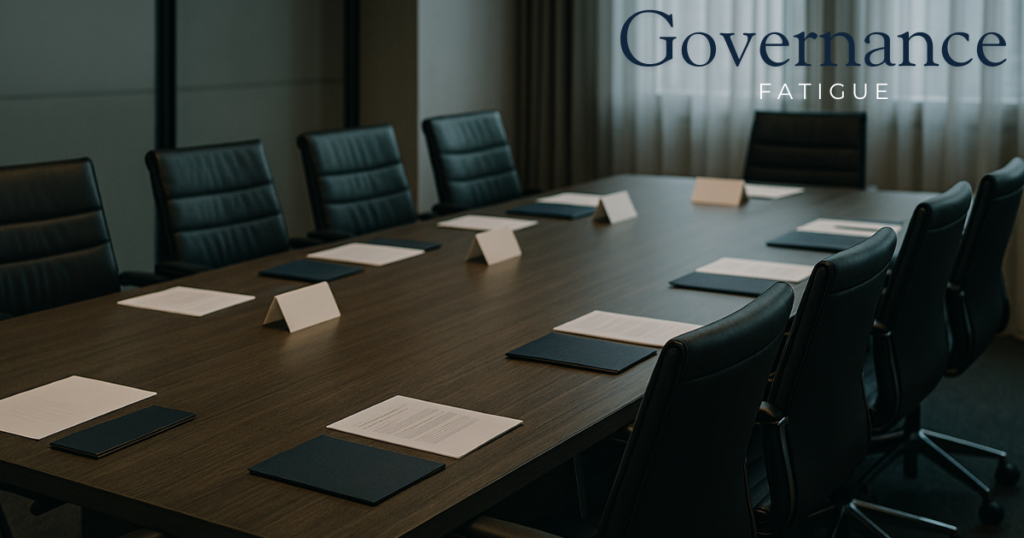

Governance Fatigue: When Risk Stops Interrupting the Room
Boards rarely fail because they didn’t see the risk. They fail because the risk stopped startling them.
In the early stages of organisational strain, deviation still cuts through. Missed targets trigger tense discussion. Control weaknesses attract serious interrogation. Regulatory letters change the mood of the room. There is urgency in the questions and discomfort in the silence. The board is alert.
Then the same issue comes back.
Not worse. Not better. Just unresolved.
Six months later, the tone changes. The variance is described as cyclical. The delay becomes implementation complexity. The matter is acknowledged, contextualised and carried forward. A year on, the issue is embedded in forecasts, factored into strategy and quietly absorbed into expectations.
At no point did the board stop paying attention. But somewhere along the way, attention softened.
That is governance fatigue. And it rarely announces itself.
How fatigue really sets in
Governance fatigue isn’t about ignorance or laziness. Most boards experiencing it are informed, diligent and engaged. The meetings continue. The packs get thicker. The dashboards multiply. If anything, the governance rituals intensify.
But fatigue creeps in through repetition.
When the same deviation appears again and again without immediate collapse, it begins to feel survivable. What once felt urgent becomes familiar. What once unsettled the board becomes something to manage, explain and accommodate. Over time, the organisation adapts to instability rather than resolving it.
Boards don’t sit around deciding to lower standards. They respond rationally to what appears manageable in context. As losses recur, they start informing the baseline against which performance is judged instead of standing outside it.
Regulatory scrutiny turns into “ongoing engagement.” Staff turnover becomes “natural attrition.” Delays are framed as transformation friction. Litigation becomes another recurring line item.
None of these reframings are dishonest in isolation. The risk lies in what they gradually do to expectation.
The slow resetting of what feels acceptable
One of the most dangerous aspects of governance fatigue is that it does not look like disengagement. It looks like maturity. Like perspective. Like calm.
Agendas still run. Committees still report. Action plans are updated. Assurance is obtained. The machinery hums.
What quietly changes is the emotional weight attached to recurring issues.
Boards begin to spend less time interrogating what hasn’t shifted and more time explaining why that is understandable. The question becomes not “why is this still happening?” but “how do we live with it?”
This is where standards begin to drift.
Escalation thresholds are adjusted. Targets are revised down. Risk appetite statements are recalibrated “in light of operational realities.” Each adjustment feels reasonable. Together, they redefine acceptable performance.
There is a fine line between realism and resignation. Governance fatigue lives on that line.
Language is never neutral
If you want to hear governance fatigue happening, listen to the language.
Words soften before decisions do.
A “control failure” becomes a “process enhancement opportunity.” A “regulatory concern” becomes “constructive dialogue.” An “exodus of talent” becomes “market-driven mobility.”
This is not spin in the crude sense. It is familiarity doing its work.
Language shapes perception. When language softens, urgency drains away. Boards don’t challenge less because they care less; they challenge less because the issue no longer feels sharp.
The risk is not that boards stop talking about the problem. It is that they stop being disturbed by it.
Why capable boards fall into this trap
There is a psychological reality here that governance frameworks rarely acknowledge.
Boards operate under constant cognitive load. The volume of information is relentless. Not everything can be treated as a crisis. Directors learn to triage attention, focusing energy on what feels most volatile, most visible, most likely to explode.
Chronic issues that don’t blow up slip down the priority list — not because they are insignificant, but because they are familiar.
Familiarity breeds tolerance.
Behavioural science calls this the normalisation of deviance: when what once sat outside acceptable boundaries becomes tolerated simply because nothing catastrophic has yet happened. The absence of immediate failure creates false comfort.
In boardrooms, this is particularly dangerous because survival masquerades as success.
The Eskom lesson: how drift becomes reality
South Africa has lived through a very public example of this process.
Load shedding did not arrive fully formed. It escalated slowly. Maintenance backlogs were acknowledged repeatedly. Diesel spend crept upward. Stages that once felt extraordinary became routine.
What began as temporary disruption slowly settled into operating reality. Not because anyone denied the problem, but because the system adapted to it.
Governance structures adjusted alongside it. Risk was recognised, but absorbed. The extraordinary became ordinary.
And that is how institutional drift takes hold — not through denial, but through accommodation.
Governance fatigue hides in plain sight
One of the more uncomfortable truths about governance fatigue is that it often coexists with strong formal compliance.
Policies are in place. Reporting is accurate. Committees do their work. External assurance is obtained.
From the outside, governance looks sound.
Yet form is not the same as substance. A well-functioning reporting cycle means very little if the board has quietly made peace with unresolved weakness.
Over time, boards can become convinced they are “across” an issue precisely because it is well documented. Familiarity is mistaken for control.
The question subtly shifts from “is this acceptable?” to “is this manageable?”
That shift is rarely visible in the minutes. Its impact, however, is structural.
Where King V really bites
King V places ethical and effective leadership at the centre of governance. Much of the conversation focuses on compliance, disclosure and process. But the harder demand is psychological.
Ethical leadership requires sustained vigilance — the discipline to remain unsettled by what should remain unsettling.
It requires boards not only to respond when alarms sound, but to ensure that repetition does not mute those alarms over time. Independent application of mind is not a moment of intensity; it is a posture that must be actively maintained.
In organisations under constant pressure, this is particularly difficult. Instability becomes familiar. The line between temporary disruption and structural fragility blurs. Boards must decide whether they are governing decline or reversing it.
Collapse rarely comes as a surprise
Institutional failure almost never begins with a single catastrophic oversight. It begins with tolerance.
With softened language. With repeated deferral. With the quiet revision of expectations. By the time crisis arrives, standards have often already shifted.
This makes governance fatigue hard to see in real time. It unfolds gradually, wrapped in competence and reassurance.
Boards don’t suddenly fail. They slowly adapt to things they once would have refused to accept.
Reintroducing productive discomfort
Governance fatigue is not inevitable. And it is not irreversible.
One useful discipline is to periodically revisit recurring issues from a zero‑based mindset. Not “are we improving against the revised plan?” but “if this landed on the agenda for the first time today, would we tolerate it at all?”
Independent reviews are another powerful circuit breaker. Chronic issues that are “under management” benefit from external scrutiny precisely because outsiders are not desensitised by history.
Rotation of committee leadership also matters. New chairs disrupt settled narratives and often ask questions others stopped asking long ago. That disruption is healthy.
Boards should also treat repeated deferral as data. When matters are continuously rolled forward “pending further information,” the pattern itself deserves interrogation. Chronic postponement often signals discomfort or structural constraint that needs escalation, not patience.
Asking the questions that don’t fit neatly into papers
Perhaps the hardest work is reflective.
Boards need to ask themselves questions that don’t sit comfortably in dashboards:
- Have we become too accustomed to this level of performance?
- Are we explaining persistent weakness instead of correcting it?
- Has our tolerance shifted without us explicitly deciding that it should?
These are not accusations. They are obligations.
None of this suggests panic or reaction over every fluctuation. Markets are volatile. Transformation is messy. Complexity is real. Governance fatigue does not arise from pragmatism; it arises from unexamined repetition.
Drift can be reversed
Eskom’s later stabilisation shows that governance fatigue is not destiny. Renewed board focus, firmer accountability and disciplined execution gradually reset expectations upwards rather than down.
Underperformance was no longer treated as “how things are.” Reliability improved. Standards were reasserted.
The lesson is simple but demanding: when tolerance is recalibrated upward instead of downward, institutional recovery becomes possible.
Staying unsettled on purpose
Ultimately, effective governance is not defined by how much information a board receives or how many boxes are ticked. It is defined by whether directors retain the capacity to be disturbed by things that should disturb them.
Governance fatigue thrives in familiarity. Vigilance requires effort.
The responsibility of directors does not stop at recognising risk. It extends to ensuring that risk never becomes so routine that it no longer interrupts the room.
In governance, vigilance is not an episode. It is a discipline — one that must be actively defended against the quiet comfort of the familiar.
Governance fatigue doesn’t announce itself. It settles in.