
The Final Whistle Blew on a Decade of Prep. Where’s Yours?
What Spain and Argentina’s World Cup Final Teaches Business Owners and Leaders About Preparation and Diversity
Spain are world champions again. Yesterday, Ferran Torres settled a scoreless final in the 106th minute of extra time to beat Argentina 1-0. It was Spain’s second World Cup, after 2010, and it made them the first nation ever to hold both the men’s and women’s World Cup at the same time. Argentina, chasing what no men’s team has done since Brazil in 1962 – back-to-back titles – fell one match short.
Every sports desk in the world will spend this week picking apart those 120 minutes. Rodri’s grip on midfield. Lionel Messi being shut out of dangerous space in what was likely his last World Cup game. Spain conceding a single goal across the entire tournament – the meanest defensive record ever posted by a champion. All of it worth analysing.
But here’s what we want Business Owners and Leaders to sit with instead: none of what happened yesterday started this year. It didn’t even start with this tournament. The real story of that final kicked off years, in some cases more than a decade, before either team set foot in the United States.
Ten years in the making
Luis de la Fuente lifted the World Cup yesterday as the oldest coach ever to do it. He only took the senior Spain job in December 2022. On paper, that’s not a long tenure. In reality, De la Fuente has been building this Spanish generation since 2013, when he took charge of the country’s under-19 side. He won a European title at that level in 2015. He moved up to the under-21s and won another European title in 2019. He took Spain’s Olympic team to a silver medal in Tokyo.
At every step, he was developing the same pool of players he would eventually inherit as seniors – by the time this World Cup started, roughly half the squad had grown up inside a system he built himself.
Since finally taking the senior job, the results read like a highlight reel: the 2023 Nations League, a Euro 2024 campaign in which Spain won all seven matches – a tournament record – and now the World Cup. His contract has already been extended through to 2028. People who’ve worked alongside him describe a coach who knows every player and every strength in Spanish football because he was there when most of them were still teenagers, and a dressing room culture built on genuine closeness rather than forced team-building exercises.
That is not luck. That is a decade of unglamorous, deliberate groundwork that most people never saw, paying out in the one match everybody watched.
Lionel Scaloni’s story runs on a similar clock, just with a different ending. He had never held a senior head coaching job in his life before Argentina made him caretaker boss in 2018, following a chaotic exit under Jorge Sampaoli. The federation confirmed him permanently by the end of that year, a bold call on an unproven name. Eight years later, his results speak for themselves: two Copa America titles, a Finalissima win over Italy, and the 2022 World Cup – a title that ended a 36-year wait and turned Scaloni into one of the most successful coaches in Argentine history. Yesterday, he came one match away from a feat no men’s coach has managed in over sixty years. Beaten, in the end, not by a lack of talent, but by an opponent whose preparation had simply run longer and deeper.
Depth, not just talent
Here’s a detail that says more about preparation than either final score line: this World Cup had six Argentine-born coaches leading six different national teams into the tournament – Lionel Scaloni with Argentina, plus Marcelo Bielsa, Mauricio Pochettino, Gustavo Alfaro, Sebastian Beccacece and Nestor Lorenzo elsewhere on the bench.
One footballing culture, producing six completely different tactical philosophies, all competing on the same stage at the same time.
That’s not a coincidence. That’s what happens when a system is deep enough, and varied enough, to produce more than one way of winning. A pipeline that only ever produces one type of coach, one type of player, or one type of thinking is a shallow pipeline – fine until it meets an opponent who out-thought it.
Spain’s own squad made the same point in miniature. Their build shared time on the pitch between a nineteen-year-old prodigy in Lamine Yamal, the calm control of a senior midfielder in Rodri, and a supporting cast willing to come off the bench and change a game, as Mikel Merino did more than once on the way to the final.
Argentina’s squad spanned sixteen years in age, from thirty-eight-year-old Nicolas Otamendi down to twenty-two-year-olds Valentin Barco and Nico Paz – the World Cup-winning core from 2022 deliberately blended with fresh legs rather than left to age out together.
Different ages. Different specialisms. Different backgrounds and footballing educations. Put together on purpose, not by accident, that diversity is what let both finalists cope with whatever the tournament threw at them, match after match, for five weeks straight.
No solo winners
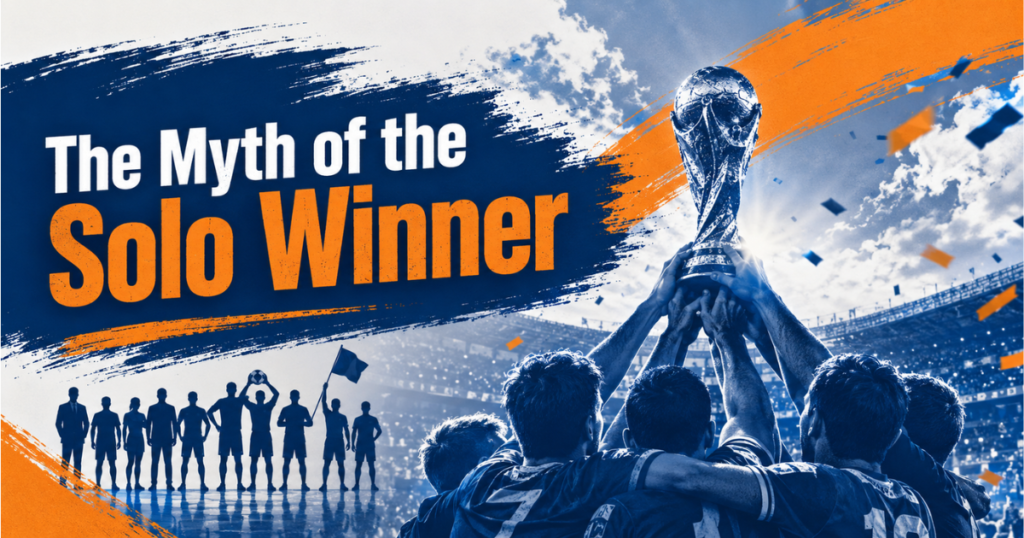
Strip away the football and you’re left with a very simple lesson for anyone running a business: nobody wins alone, and nobody prepares alone either.
Lionel Messi did not win yesterday’s final on his own talent, and he has never needed to. Behind him sat a head coach with eight years of accumulated judgement, a technical bench of specialist assistants, medical staff, video analysts, and senior teammates who had earned the right to tell him things he might not want to hear. Take any of that away and Argentina don’t reach a final at all, let alone come within a missed chance of history. The same is true for De la Fuente and Spain. Genius on the pitch is real. Genius alone, with nobody around to challenge, plan and prepare for years in advance, wins nothing.
Business Owners and Leaders in South Africa tend to build the opposite way. Most private, family-run businesses get built on hustle – one person who’s first in, last out, who solves every fire before it spreads, who makes every call because for years they were the only person qualified to make it. It works. It has to work, in the early days. And then the business gets bigger than the person running it, and the habits that built the thing start quietly working against it. There’s no board looking over your shoulder. No backroom staff catching what you miss because you’re too close to see it. No one asking the uncomfortable question before a client, a competitor, or a bank manager asks it for you.
That’s precisely the gap a TAB Peer Advisory Board (PAB) exists to close.
What a Peer Advisory Board actually gives you
A PAB is a roundtable of Business Owners and Leaders from different industries and backgrounds, meeting regularly to work through the real, current problems in each other’s businesses – not theory, not a generic course, actual issues on the table with actual people who have skin in the game of running a business themselves. It’s paired with one-to-one coaching focused specifically on you, and a structured strategic planning tool – the Blueprint – that turns boardroom talk into a plan you can actually execute and measure.
The point of the diversity around that table is not a nice-to-have. It’s the entire mechanism. A roomful of people from the same industry, the same background, and the same blind spots will agree with you faster and help you less. A board built deliberately across sectors, ages, and experience – the same principle that put a nineteen-year-old and a thirty-four-year-old on the same World Cup-winning pitch – is what surfaces the answer you wouldn’t have found staring at your own numbers alone.
TAB has been running this model since 1990 and now operates in 27 countries, having worked with more than 25,000 businesses globally – figures TAB reports itself as a network, not independently audited numbers, so take them as the scale of the network rather than a scientific claim.
What we can say with more confidence, because it comes straight from our own members via internal surveys, is that 68% of TAB members report their turnover has increased since joining a board, and 87% report their leadership skills have improved. Those are self-reported figures from our own membership, not third-party research, and we say so plainly – but they line up with what TAB-commissioned research through George Washington University and Case Western Reserve University has also found around accountability and peer structures driving better business outcomes.
Who’s in your dugout?
Spain didn’t win a World Cup because Luis de la Fuente happened to get lucky with a golden generation of players in the summer of 2026. They won it because a system was built with intent, over more than a decade, staffed by people with different jobs, different specialisms, and the standing to challenge the top of the tree when it mattered. Argentina didn’t fall one match short because Scaloni or Messi ran out of talent. They ran into an opponent whose preparation, on the whole, simply had more depth built into it.
If you’re a Business Owner or Leader in South Africa running a business with real staff, real turnover, and no formal board holding you to account, ask yourself the question a Peer Advisory Board is built to answer: who’s actually in your dugout? Who’s watching your blind spots, calling the tactical shift before you need it, and telling you the truth instead of what you want to hear?
If the honest answer is nobody, that’s worth fixing before your next big match, not after you’ve already lost it.
#Leadership #Coaching #BusinessBuildersAdvantage #TheAlternativeBoard #PeerAdvisoryBoards