
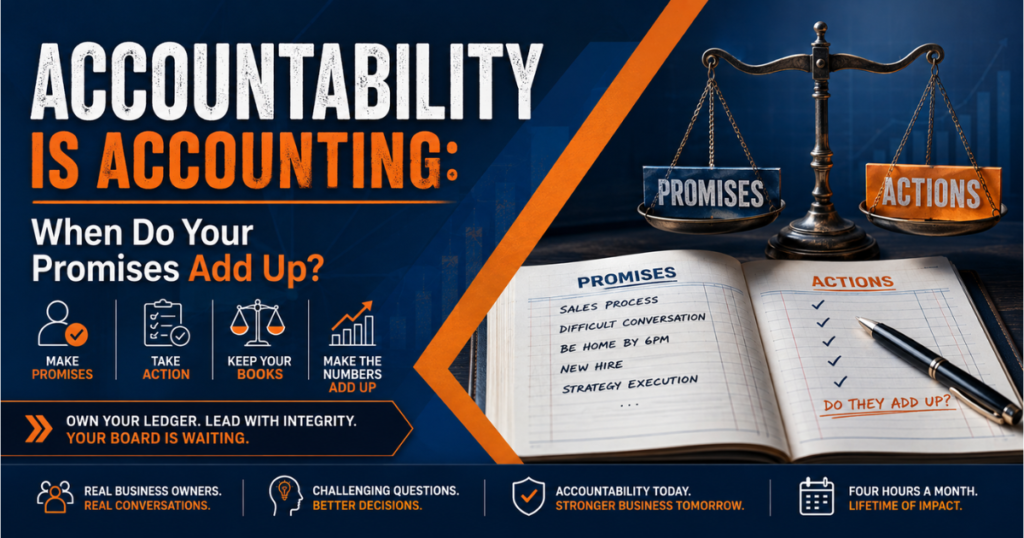
Accountability Is Accounting: When Do Your Promises Add Up?
A line on LinkedIn last week got my attention: “Accountability is the accounting of your promises and your work – at some point the numbers must add up.”
Read that twice. Then a third time, because it’s the kind of sentence that quietly calls you out.
Most Business Owners and Leaders treat accountability like a soft skill. A value on the wall next to “integrity” and “excellence”, printed in a nice font, meant nothing by anyone. But the quote strips that away. Accountability isn’t a value. It’s a ledger. Every promise you make – to your staff, your clients, your bank, yourself – goes into a column. Every action you actually take goes into the other column. And like any set of books, if the two columns don’t balance, you’ve got a problem. You can dress it up, explain it away, blame the market, blame politics, blame your ex-business partner. Doesn’t matter. The numbers still don’t add up.
Most Business Owners in South Africa are the only ones checking their own books.
The Problem With Marking Your Own Homework
You started the business. You run the business. You promoted yourself into every senior role because there was nobody else to do it. Which means, somewhere along the way, you also appointed yourself as the person who decides whether you kept your promises.
That’s a conflict of interest if I’ve ever seen one.
Think about how that plays out.
You tell yourself you’ll fix the sales process by March. March comes and goes. You’re the boss, so you grant yourself an extension. You tell yourself you’ll finally have the difficult conversation with your underperforming manager. You don’t. You’re the boss, so nobody schedules a follow-up. You promise your spouse you’ll be home by six three nights a week. You’re not. Nobody’s clocking you out.
None of this makes you lazy or dishonest. It makes you human, and it makes you isolated – which, in a Business Owner, amounts to the same thing.
Research into entrepreneurial isolation keeps landing on the same finding: Business Owners who lack a genuine peer network make worse decisions, not because they’re less capable, but because they’re reasoning alone, without anyone close enough to the problem to push back. You can be the hardest-working person in the room and still be wrong, if you’re the only one in the room.
That’s the trap.
A Business Owner without a board isn’t accountable to anyone but their own internal monologue, and internal monologues are notoriously easy to negotiate with. “I’ll get to it next quarter” sounds perfectly reasonable when the only person you have to convince is yourself.
Why a Board of Directors Exists (and Why You Don’t Have One)
Listed companies have boards for exactly this reason. Not because shareholders love meetings, but because somebody independent needs to sit across the table, ask the hard question, and refuse to accept “I’ve been busy” as an answer. A functioning board audits the promises.
Did revenue growth happen the way you said it would? Did the new hire work out? Did you actually execute the strategy you presented with such confidence in January?
The thing about most South African Business Owners and Leaders in the R20 million to R1 billion turnover bracket, running single-owned or family businesses: you don’t have one of those boards.
You built something real, employing real people, carrying real risk on your own balance sheet – and you did it without the one structure that’s specifically designed to keep a leader honest. Not because you didn’t want accountability. Because nobody built you a version of a board that fits a private, owner-run business.
That’s the gap a Peer Advisory Board closes.
What a Peer Advisory Board Actually Does
Strip away the branding and a Peer Advisory Board (PAB) is a monthly appointment with people who have no reason to let you off the hook. At TAB, that means a small group of non-competing Business Owners and Leaders – no more than eight of you – sitting in a room for four hours once a month, with a certified facilitator running the session so it doesn’t turn into a moaning circle or a networking breakfast.
You bring a real issue. Not a polished, pre-approved version of the issue – the actual, messy, “I haven’t told anyone this yet” issue. The Board interrogates it. They ask the questions your management team is too junior, too polite, or too scared to ask. They’ve usually faced a version of your problem in their own business, so you get advice grounded in scar tissue, not theory. And crucially, they remember what you said last month. When you show up again, they ask what happened with it.
That’s the accounting part. Every commitment you make in that room gets carried forward as a line item, and next month, someone checks whether it landed.
Alongside the PAB sessions, your PAB facilitator meets with you individually for a one-on-one monthly session of up to two hours – working through your Blueprint, the tool that turns vague ambition into a plan with actual KPIs attached to it.
The facilitator’s job isn’t to cheer you on. It’s to sit with you and measure, honestly, whether the promise and the performance line up. If they don’t, that’s the conversation – not next quarter, this month.
Put the two together and you’ve built the exact mechanism a listed company gets from its board: a standing, recurring, unavoidable audit of your own word.
The Provocative Bit
Here’s where I’ll push back on you directly, because that’s what this article is supposed to do.
If you’ve read this far nodding along, thinking “yes, I need that”, ask yourself honestly why you don’t already have it.
It’s not cost – a PAB costs less than the mistakes you make reasoning alone in a closed room.
It’s not time – you’re already spending hours every month having the same argument with yourself that a Board would resolve in one sitting.
It’s ego.
Somewhere in there is a voice telling you that needing outside accountability is an admission that you can’t run your own show.
Flip that. The Business Owners and Leaders who resist a Peer Advisory Board the hardest are usually the ones who need it most, because the resistance itself is the symptom – it’s the same avoidance that’s been quietly letting the promises and the numbers drift apart for years. The strongest leaders aren’t the ones who never need to be checked. They’re the ones who built a structure that checks them anyway, on purpose, before the market does it for them.
And the market will do it for you, eventually. Cash flow doesn’t care how convincing your excuses are. Neither does a resigning key employee, a lost tender, an interest rate hike, a rand that moves 8% in a month, or a competitor who acted while you were still deliberating.
South African Business Owners already operate with enough variables outside their control – politics, currency swings, a tender process that changes its own rules halfway through.
Accountability is the one variable you can actually control. Accountability you impose on yourself, on your own terms, in a room full of peers who want you to win, is a far better audit than the one the market runs when you’re out of options.
It Cuts Both Ways
This isn’t only about catching you when you slip.
A proper Board audits the good months too, and that matters just as much. Business Owners are notoriously bad at pausing to ask why something worked – a good quarter gets absorbed and forgotten, and the lesson evaporates before it can be repeated on purpose.
A PAB that meets you every month forces you to explain your wins with the same rigour it demands for your excuses. Did that campaign actually drive the growth, or did a big client just place an unusually large order? Was it your pricing change, or was it luck?
Get that wrong and you’ll “double down” on the wrong thing next quarter and wonder why it didn’t work twice.
TAB describes the facilitator’s role as someone who “jumps in the quicksand with you” rather than standing on the bank shouting instructions. That’s the distinction between a PAB and a consultant, a mentor, or a course.
A consultant delivers a report and leaves. A PAB is in it with you, monthly, whether the news is good or bad, and it remembers everything you said the last time you were in the room.
What The Numbers Actually Say
TAB doesn’t ask you to take this on faith. Across TAB’s global membership, businesses that belong to a Peer Advisory Board report profitability running at roughly 2.5 times that of comparable businesses without one. That’s not a coincidence, and it’s not because peer groups are magic. It’s because owners who are answerable to a Board every month stop letting promises quietly expire. They close the gap between what they said and what they did, month after month, and profit is what shows up when that gap closes.
Compare that to the alternative: another year of good intentions, personally audited by the one person on earth with every incentive to grade themselves generously.
The Numbers Must Add Up
Go back to the line that started this. Accountability is the accounting of your promises and your work, and at some point the numbers must add up. You can keep those books yourself, alone, with all the built-in bias that comes from being both the bookkeeper and the Business Owner. Or you can put a Board around the table that does what any good board does – checks the entries, questions the assumptions, and refuses to sign off until the numbers actually reconcile.
Business Owners and Leaders don’t fail because they lack ambition or promise too little. They fail because nobody’s checking whether the promises got kept. A Peer Advisory Board is that check. Not a soft, supportive chat about your feelings on running a business – a standing appointment with people who will ask you, every single month, whether the numbers add up.
They either will, or they won’t. Better to find out from a room of people who want you to succeed than from a bank statement that doesn’t care either way.
If you’re a South African Business Owner or Leader running a single-owned or family business, turning over between R20 million and R1 billion, with no formal board of directors watching your numbers – that’s exactly who a TAB Peer Advisory Board is built for. Find your nearest board and see what it’s like to have your promises checked by people who won’t let you off the hook.
#Leadership #Coaching #BusinessBuildersAdvantage #TheAlternativeBoard #PeerAdvisoryBoards