
Don’t Be an Air Conditioner: Why “What’s Next?” Is the Wrong Question After You Hit a Goal
A post did the rounds on LinkedIn recently that stopped me mid- scroll. It came out of a TAB Board meeting, where someone shared an analogy so simple it almost felt unfair.
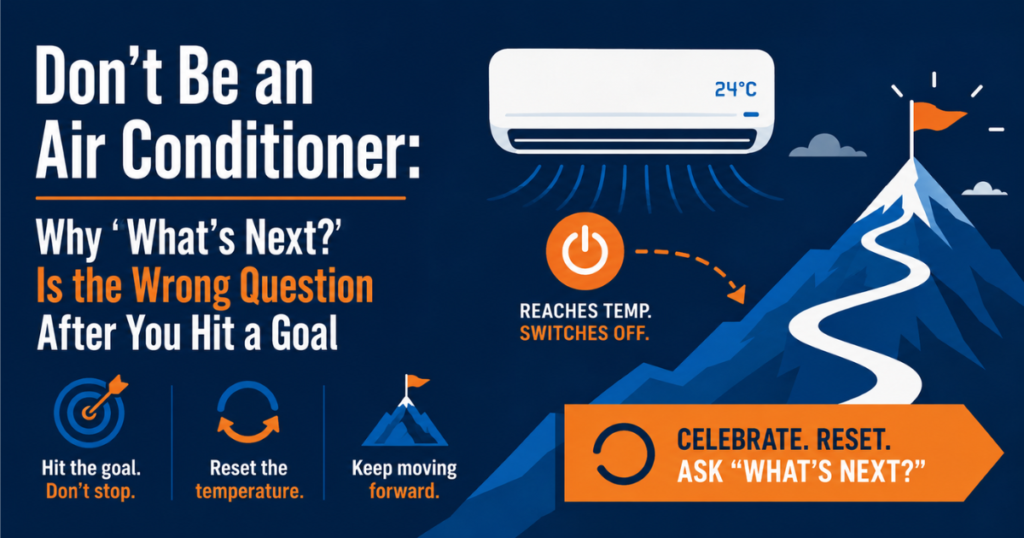
An air conditioner is set to a temperature. It reaches that temperature. It switches off.
How many Business Owners do exactly the same thing? You set a turnover target, a profit target, a personal milestone. You hit it. And then, without quite noticing, you ease off the accelerator. The post’s challenge was blunt: great Business Owners don’t switch off when they reach a goal, they ask “What’s next?” Celebrate the milestone, then reset the temperature. Don’t be an air conditioner.
I like the analogy. I liked it enough to argue with it in the comments, because the more I sat with it, the more I realised most Business Owners aren’t switching off because they’re lazy or unambitious. They’re switching off because they never understood what the goal was actually for in the first place.
The Air Conditioner Was Never the Point
The thing about an air conditioner… its purpose was never to reach a temperature. Its purpose is to provide comfort. The temperature is just the setting we use to get there, and we change that setting as conditions change. Cold snap in July, heatwave in January, more people in the room, a different mood entirely. The unit doesn’t have a “final” temperature it’s working towards. It has a job: keep this space liveable, whatever the day throws at it.
Your business works the same way. It’s not the point of your life. It’s the tool you built to get to the point of your life, whatever that is for you, comfort, security, freedom, legacy, the ability to coach your kid’s rugby team on a Tuesday afternoon without checking your phone every four minutes. A turnover target or a profit number is a temperature setting on that tool. It’s a short-term marker that should be pulling you towards something bigger, not a finish line that lets you stop.
So when a Business Owner hits their number and switches off, the honest question isn’t “why did they stop pushing?” It’s “did they ever actually know why they were pushing?” If the goal was the whole story, of course you stop once you’ve told it. If the goal was one chapter in a much longer story about the life you’re building, stopping was never on the table, because the story isn’t finished.
This is not a small distinction. It’s the difference between a Business Owner who plateaus at a certain turnover for six years running, and one who uses that same number as a launchpad for the next phase. Business growth research backs this up in less philosophical language: plateaus rarely happen because a market dried up. They happen because the owner ran out of a reason to keep going past the number they’d already written down. The strategy that got a business to a certain size stops being examined, the same systems keep getting reused past their sell-by date, and “what’s next” becomes an afterthought instead of a built-in feature of how the Business Owner thinks.
Reaching a Goal Was Never Going to Make You Happy Anyway
There’s a well-documented psychological trap that explains why so many high achievers feel flat, not fired up, the moment they cross a finish line. Psychologists call it the arrival fallacy, a term popularised by Harvard’s Tal Ben-Shahar: the deeply human, deeply wrong belief that reaching a particular destination, the sale, the turnover figure, the exit, will deliver lasting happiness or permission to relax. It doesn’t. The satisfaction is real, but it’s brief, and then life carries on wanting the same things from you it always did: purpose, growth, contribution, comfort as you define it.
If you’ve built your entire motivational engine around “I’ll be sorted once I hit X,” you are setting yourself up for a very expensive anticlimax. Worse, you’re setting your business up to coast, because the person steering it has quietly decided there’s nothing left to steer towards. This is exactly the air conditioner problem, except now we can see it isn’t a discipline issue. It’s a design flaw in how the goal was set to begin with.
The research on effective goal-setting, going back to the foundational work of Edwin Locke and Gary Latham, tells us goals only drive performance when they’re specific, challenging, and tied to real commitment and feedback. What that research doesn’t spell out, because it wasn’t the question being asked, is what happens the day after you hit the target. That’s the gap most Business Owners fall into. They know how to set a good goal. Almost nobody teaches them how to set the next one before the current one lands, so that “what’s next” is never a question asked in a panic after the fact, but an answer that was already loaded before the finish line was crossed.
Phases Change. Your Goals Should Too.
Life doesn’t hold still, and neither does business. The goal that made sense when you had eight staff and were fighting for cash flow is not the goal that makes sense with forty staff and a market you now dominate. Each phase has its own version of “comfortable,” and each version needs its own temperature setting.
The mistake isn’t setting goals. It’s setting one goal, achieving it, and only then scrambling to work out what comes next, as if growth were a surprise rather than the plan. A goal worth having should already contain the seed of the next one. Why you’re chasing this year’s number should be the reason next year has a bigger one, and that chain, “why leads to what’s next, which leads to the next why,” is what separates a Business Owner with a strategy from a Business Owner with a scoreboard.
If you genuinely need to sit down and ask “what’s next?” after hitting a goal, that’s worth being honest about: it usually means the goal was disconnected from anything bigger than itself. Short-sighted goals produce exactly this kind of stall, because they were never wired into a longer-term picture of comfort, freedom, or purpose. The fix isn’t more hustle. It’s better wiring.
Why You Can’t See Your Own Blind Spots
The uncomfortable part… Most Business Owners can’t diagnose this in themselves, not because they’re not smart enough, but because they’re too close to it. You’re inside the business every single day. You know its problems intimately and its bigger purpose vaguely, if at all, because nobody’s ever made you sit still long enough to articulate it. Ask a Business Owner what their turnover target is for next year and you’ll get an answer in seconds. Ask them why that number matters, what it’s actually in service of, and where it leads three phases from now, and you’ll often get silence, or a version of “I hadn’t really thought about it that way.”
This is precisely the gap a Peer Advisory Board is built to close.
What a Board Actually Does With “What’s Next?”
A TAB Peer Advisory Board puts you in a room, monthly, with no more than eight other Business Owners and Leaders who run completely different businesses to yours but share the same fundamental job: steering something they built through constant change. No competitors. No employees. No one with a stake in telling you what you want to hear. Just people who have hit their own version of the target temperature and had to answer, honestly and often uncomfortably, what came after it.
That structure matters more than it sounds like it should. A board of people who are not inside your business sees the wiring you can’t see from your own desk. They’ll ask why your goal matters before they help you hit it. They’ll notice when you’re chasing a number for its own sake rather than because it connects to something bigger, and they will say so, directly, in the room, the same month it happens rather than three years later when the plateau has already set in.
Alongside the monthly board sessions, TAB pairs every member with one-on-one coaching to build out the strategic plan behind the goal, not just the goal itself. That’s where “what’s next” stops being a scramble and starts being a built-in step in the plan, mapped out before you need it rather than invented in a panic afterwards. Add the tools on TAB’s proprietary Business Blueprint platform for tracking the plan in black and white, and you’ve got a structure that makes it very hard to quietly switch off without at least seven other people in the room noticing and asking why.
This isn’t a theoretical fix. TAB has been running this model since 1990, and it now operates across 27 countries with more than 20 000 Business Owners and Leaders having gone through the system. In South Africa, we’ve been doing this since 2018, working specifically with owners of single-owned and family-owned businesses, unlisted, at least ten staff, five years or more in business, turnover between R20 million and R1 billion, and typically no formal board of directors holding them to account. If that’s you, you are exactly who this was built for.
Reset the Temperature, But Know Why You’re Resetting It
Don’t be an air conditioner. Fine advice. But don’t stop there either, because switching the unit back on without checking whether the room’s needs have actually changed is just busywork dressed up as ambition. The real move is to celebrate the milestone, understand precisely why it mattered, and let that understanding tell you what the next setting should be, before you need to ask “what’s next” out loud.
Great Business Owners and Leaders don’t run from goal to goal hoping the next one reveals itself. They build businesses that know their own purpose well enough that the next phase is already visible from inside the current one. That kind of clarity rarely comes from working harder inside your own head. It comes from a room full of people who are willing to ask you the question you’ve been avoiding, and then help you actually build the answer.
#Leadership #Coaching #BusinessBuildersAdvantage #TheAlternativeBoard #PeerAdvisoryBoards