
Nobody Called the Foul
What Caitlin Clark’s Bruises Teach Business Owners and Leaders About Protecting Their Best Player
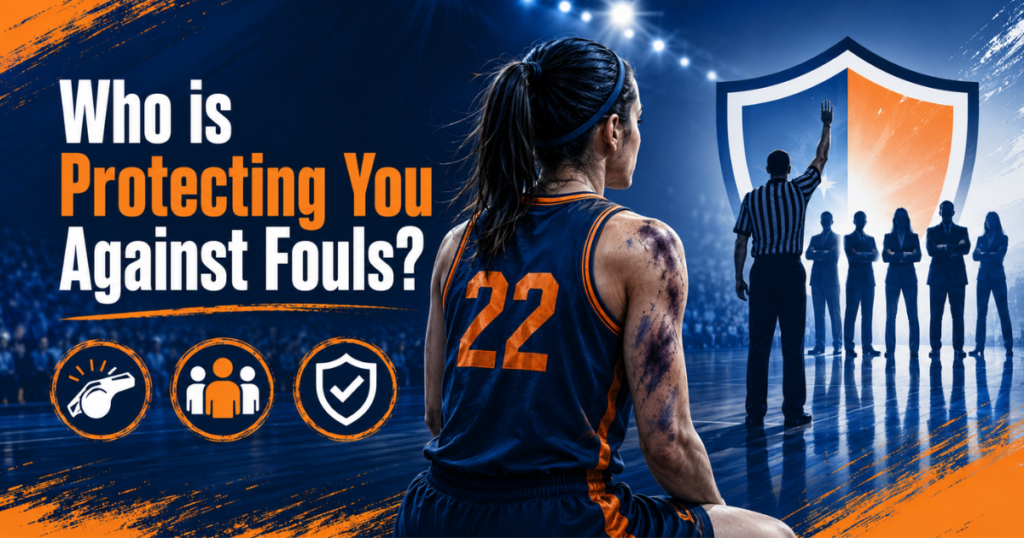
Caitlin Clark has been hip-checked, poked in the eye, and hit in the throat this season. Not in a bar fight. In a professional basketball game, on national television, in front of sponsors who are paying to be there.
On 24 June 2026, Phoenix Mercury forward Alyssa Thomas drove her fist into Clark’s throat during a game at Gainbridge Fieldhouse. No foul was called in the moment. The league reviewed it afterwards, upgraded it to a Flagrant 2, and suspended Thomas for one game. Thomas has since said the contact was “a complete accident” and revealed she received death threats in the aftermath – which is its own ugly story, and not one anyone should be cheering for either.
Two weeks later, eleven members of the U.S. House Republican Study Committee wrote directly to WNBA Commissioner Cathy Englebert. Their letter didn’t mince words: what fans are witnessing, they said, “is not simply aggressive competition, but repeated acts of physical hostility.” Congress gave the league until 24 July 2026 to respond. Indiana Fever head coach Stephanie White has been blunt in press conferences too, calling missed calls on Clark “absolutely egregious and utterly disrespectful.”
Here’s the bit that should make every Business Owner and Leader sit up: Clark is, by a wide margin, the single biggest commercial asset the WNBA has ever had. She has driven ticket sales and television ratings to levels the league has never seen. And she is the one absorbing the physical cost of that value, largely alone, while the institution around her argues about whether to intervene.
Sound familiar?
The Business Owner Is the Franchise Player
Swap the basketball court for a boardroom and the pattern holds up disturbingly well. The Business Owner or Leader is usually the person generating the disproportionate share of value in their business – the relationships, the decisions, the reputation, the deals that keep the lights on for everyone else. And they are also, usually, the one absorbing the disproportionate share of the hits: the cash flow scare nobody else sees, the staff crisis at 23h00, the supplier who lets them down, the market shock that lands on their desk and nowhere else.
The rest of the organisation benefits from the value the owner creates. Very few structures exist to protect the person creating it.
“You got to call the foul.” – Stephanie White, Indiana Fever head coach, on officials failing to protect Clark from repeated physical contact.
White’s frustration wasn’t really about one missed whistle. It was about a pattern: an asset absorbing repeated, cumulative punishment while the system responsible for protecting her reacted too slowly, and only after outside pressure – fans, media, eventually Congress – forced the issue.
Most Business Owners and Leaders don’t have a Congress writing a letter on their behalf. They don’t have a coach standing at a podium demanding better officiating. They have nobody in the building whose job it is to say, out loud, “that hit was out of order, and it’s happening too often.” So they absorb it, keep playing, and call it resilience.
It isn’t resilience. It’s an unprotected asset.
The Load-Bearing Wall Doesn’t Get to Rest
Clark’s own injury history makes the point even sharper. In 2025 she played just 13 games, sidelined by a string of soft-tissue injuries – a quad strain in May, then recurring issues that ended her year with a groin injury in July. She still earned an All-Star nod on the strength of what she’d shown before the injuries hit. In 2026 she came back leaner, added muscle over the off-season, played her way through a FIBA World Cup qualifying tournament as tournament MVP, and was voted into her third straight All-Star Game this year – all while managing a back injury and a minutes restriction.
Notice what didn’t change in that story: the volume of contact she absorbs every time she’s on the floor. What changed was her conditioning, not the environment around her. She trained harder to withstand a problem the league itself hadn’t fixed.
That’s precisely what happens inside businesses that lack structural protection for their owner. The Business Owner works longer hours, reads more books, gets fitter, gets more disciplined, gets better at compartmentalising stress – all sensible things to do – while the actual environment around them stays exactly as unprotected as it always was. Personal resilience becomes the whole strategy, because it’s the only lever anyone thought to pull. It is necessary. It was never supposed to be sufficient on its own.
Calling the Foul Without Starting a Mob
There’s a second, less comfortable lesson in this story. After the league suspended Alyssa Thomas for the throat incident, she said the contact was accidental – and then reported receiving death threats. Clark and coach White both publicly condemned that reaction. It’s worth sitting with that for a moment: even Clark, the player on the receiving end, didn’t want the correction to turn into a public pile-on.
That distinction matters for how a PAB operates too. Calling the foul is not the same as public humiliation, and accountability is not the same as pile-on. A good board challenges a Business Owner’s blind spot in a closed, confidential room, among peers who have no interest in embarrassing them and every interest in seeing them succeed. That’s a very different mechanism from a social-media dogpile or a boardroom ambush – and it’s precisely why it works.
People change course when the feedback is direct and constructive. They dig in when it’s public and hostile.
Toughness Is Not a Strategy
Nobody is arguing Clark should stop playing hard, or that competitive contact has no place in professional sport. The WNBA has always been physical, and that’s part of its appeal. The argument – Congress’s, White’s, and increasingly the players’ own union’s – is that there’s a difference between competitive physicality and repeated, uncalled, targeted contact that goes unaddressed until it becomes a national story.
The same distinction applies in business. Pressure is not the enemy. Every Business Owner and Leader worth their title has absorbed brutal weeks, brutal clients, brutal decisions, and come out the other side sharper for it. The problem isn’t pressure. The problem is pressure with no structure around it – no one calling the foul, no one flagging the pattern, no one asking whether the owner is actually okay before it becomes a crisis serious enough that outsiders have to step in.
By the time a Congressional letter gets written, the damage is already done. By the time a Business Owner’s health, marriage, or business finally cracks under unmanaged pressure, the damage is already done too. Both are examples of protection arriving after the fact instead of before it.
What Structural Protection Actually Looks Like
This is where a Peer Advisory Board (PAB) earns its keep – not as a support group, and not as a motivational circle, but as structural infrastructure that does for a business what a good coaching staff and league office are supposed to do for a star player: watch closely enough, and honestly enough, to call the foul before the damage compounds.
A PAB is a confidential roundtable of other Business Owners and Leaders, meeting monthly, who have no stake in being polite to you and no reason to let you coast on your own explanation of events. Alongside the board sits one-to-one coaching with your TAB Facilitator, and access to the Blueprint – a structured planning tool that keeps strategy honest rather than aspirational.
Three things a PAB does that a Business Owner absorbing hits alone cannot do for themselves:
First, it sees the pattern, not just the incident. One bad month is a bad month. Three bad months with the same root cause is a pattern nobody spots from inside their own business – the same way one hard foul is competitive basketball, but a season of uncalled hits is a structural failure. A board of peers, meeting regularly, catches the pattern early.
Second, it calls the foul you can’t call on yourself. Business Owners are notoriously bad at flagging their own blind spots – the underperforming hire they’ve excused for a year, the pricing model that stopped working eighteen months ago, the personal burnout they’ve relabelled as “just a busy season.” A PAB is made up of people paying close enough attention, and secure enough in their own standing, to say the uncomfortable thing out loud.
Third, it takes some of the weight off the one person carrying it. Clark plays with four teammates on the court and a bench behind her. Most Business Owners and Leaders make the biggest calls in their business with nobody else in the room. A PAB doesn’t run the business for you, but it means the next hard decision isn’t made in total isolation.
The Numbers, With the Right Caveats
TAB has supported more than 25,000 businesses across 27 countries since 1990. Among current TAB SA members surveyed, 68% report increased turnover since joining, and 87% report improved leadership skills. These are self-reported member figures from TAB’s own tracking, not independently audited research, and we say that plainly rather than dressing them up as something they’re not.
What they do reliably indicate is member-perceived value over time, across a large and long-running international sample – which is a meaningful signal, even with that caveat attached.
What the numbers can’t capture, and what matters more, is the thing that doesn’t show up until it’s tested: whether there was someone in the room when a Business Owner needed a foul called on their own decision-making, before the situation became a crisis rather than a correction.
Who’s Calling Yours?
The WNBA is now being forced, publicly and under political pressure, to build better structures to protect its most valuable asset – after the fact, after the letters, after the suspensions, after the headlines. That’s one way to get there.
The other way is to build the structure before you need Congress to write the letter for you.
If you’re the Business Owner or Leader absorbing every hit your business takes, with nobody in the room whose job it is to call the foul, that’s not toughness. That’s an unprotected asset waiting for its own bad headline. A Peer Advisory Board exists to make sure that call gets made a long time before it needs to be.