
The 3:17am Club: What South Africa’s Business Owners Aren’t Telling Anyone
There’s a very specific kind of tired that only Business Owners and Leaders seem to know. It isn’t the tired that a good night’s sleep fixes, because there wasn’t a good night’s sleep to begin with.
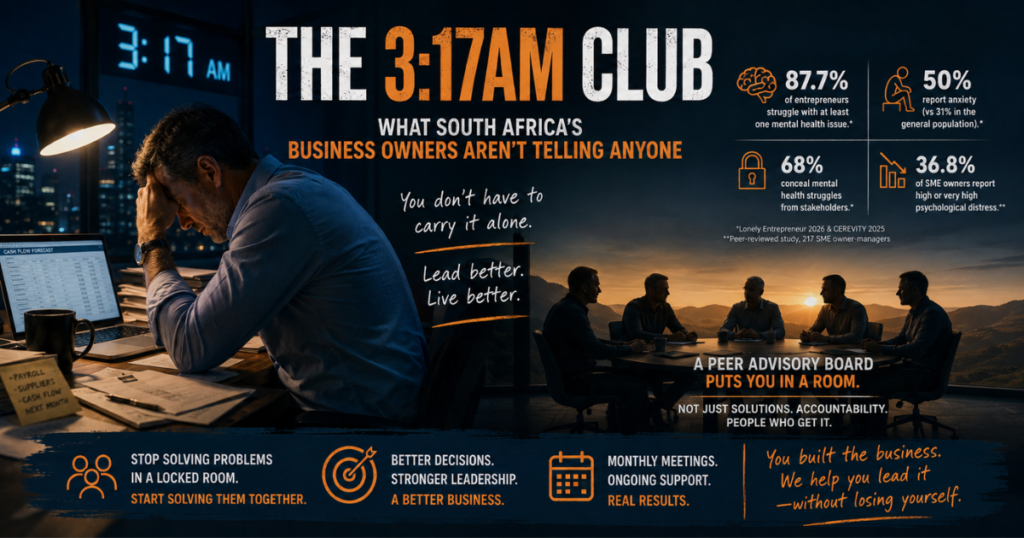
A 2025 Old Mutual SMEgo survey, the first study of its kind conducted in South Africa, found something oddly precise: a striking number of small Business Owners are wide awake at 3:17am, running payroll numbers, supplier disputes, and next month’s cash flow through their heads on a loop. It’s the hour when the mind, freed of daytime distractions, goes looking for the problems it hasn’t solved yet.
It’s the hour when the mind, freed of daytime distractions, goes looking for the problems it hasn’t solved yet.
If you’ve been there, you already know this isn’t really an article about sleep. It’s about what’s sitting underneath it.
The stats nobody puts on a pitch deck
Let’s start with the uncomfortable numbers, sourced properly so you can trust them and where they came from.
The Old Mutual SMEgo Entrepreneurs Health and Wellbeing Survey, South Africa’s first study of its kind, surveyed 138 entrepreneurs across industries and income bands. It found that stress shows up differently depending on how much money is coming in, but it shows up for everyone.
Entrepreneurs earning below R500,000 a year reported deep isolation, being locked out of business networks and funding conversations.
Those earning R500,000 to R1 million carried anxiety tied to growth decisions and reinvestment risk.
The R1 million to R5 million bracket wrestled with cognitive overload and competitive pressure.
Above R5 million, the strain shifted to stakeholder and performance pressure.
The food and beverage sector flagged regulatory anxiety and perishable stock losses as a constant undercurrent.
Health and wellness Business Owners described the strain of choosing between professional ethics and business survival.
Construction sector respondents pointed to systemic corruption forcing a similar, uglier version of the same choice.
Internationally, the picture is even starker. The Lonely Entrepreneur’s 2026 global founder survey, covering 227 founders across 46 countries, found that 87.7% of entrepreneurs struggle with at least one mental health issue: anxiety, high stress, financial worry, burnout, or impostor syndrome.
Half report anxiety, well above the roughly 31% lifetime rate in the general adult population.
A quarter report feeling lonely or isolated specifically, in the survey’s own words, the one issue nobody puts on a pitch deck.
A separate 2025 CEREVITY survey of tech founders found that 68% are actively concealing their mental health struggles from investors, boards, and other stakeholders, and 61% cite fear of professional consequences as the reason they’ve never sought therapy. And in a peer-reviewed study of 217 SME owner-managers published in an occupational health journal, 36.8% reported high or very high psychological distress. Of that distressed group, 82.5% reported presenteeism days, meaning they were physically at work but operating at roughly half their normal output. That’s not a mental health footnote either. That’s a direct hit to the business.
None of these numbers describe weak people. They describe a structurally lonely job, doing exactly what it does to the people carrying it.
Why the top of the business is the loneliest room in it
Employees have colleagues to vent to, managers to escalate to, and, in bigger companies, an HR department built to catch some of the fallout. Business Owners and Leaders have none of that by design.
You are, quite literally, the last line of defence for every decision, every bad debtor, every staff member who didn’t pitch, every input cost that jumped without warning.
You’re also surrounded by people who need you to look fine. Staff need confidence. Family needs reassurance. Customers need certainty. So the same person carrying the heaviest, most uncertain load in the business is also the person with the fewest places to safely put it down. That’s the concealment stat from CEREVITY playing out in real time: struggling in private while performing certainty in public, because the alternative feels like it could cost you the business, the team, or the investors.
That’s not a mental health footnote. It’s the core structural problem TAB Peer Advisory Boards were built to solve, decades before “founder burnout” became a phrase anyone said out loud.
The ripple effect: it doesn’t stop with you
Here’s the bit that tends to get missed. An exhausted, isolated Business Owner or Leader doesn’t just suffer privately while the business carries on as normal. The business feels it too.
Decision quality drops first, usually quietly. Tired, unsupported leaders default to the fastest available answer rather than the best one, because there’s no one in the room to slow them down or offer a second opinion. Staff notice the mood shifts before anyone says a word about it, and culture tends to follow the owner’s state more closely than any mission statement ever will. Family life absorbs whatever’s left over at the end of a long day, which is often not much.
None of this is a character flaw. It’s what happens when one person is quietly expected to be the strategist, the accountant, the HR department, the therapist for everyone else, and the person holding it all together, without a single peer who actually understands the specific weight of running a business in this economy, in this country, right now. Something eventually gives, and it’s rarely the business that gives first.
What a Peer Advisory Board actually changes
A PAB isn’t therapy, and it isn’t a support group, though it borrows something useful from both. It’s a room of non-competing Business Owners and Leaders from different industries, meeting monthly under a trained facilitator, your Facilitator, whose job is to challenge your thinking, pressure-test your decisions, and hold you accountable to the plans you say you’ll execute.
The part that matters for mental health specifically: it works because everyone in that room has stood exactly where you’re standing. They’ve had the 3:17am moment. They’ve made the call nobody else could make and lived with the outcome alone. When you bring a genuine problem into that room, you’re not confessing weakness to people who’ll judge you for it. You’re handing a live problem to people who’ve solved versions of it before, and who have zero commercial interest in your business failing, because they don’t compete with you.
You stop solving problems in a locked room inside your own head.
That shift, from carrying a decision entirely alone to carrying it alongside people who understand the actual weight of it, is where a lot of the isolation drains out of the job. Not because the problems get smaller. Because you stop solving them in a locked room inside your own head.
Between monthly board meetings, one-on-one leadership coaching sessions with your Facilitator keep the momentum going, with your goals and follow-through tracked through TAB’s Blueprint platform so nothing quietly slips. It’s a structure built to catch problems, and the person carrying them, well before either one reaches crisis point.
TAB’s own numbers, and why we’re telling you exactly how solid they are
TAB has been running this model since 1990, now across 27 countries, with more than 25,000 businesses having gone through it. Our own member surveys report that 68% of members experience increased turnover and 87% report improved leadership as a direct result of being on a board. We also reference a 2.5x average revenue growth figure from our own published material.
We want to be straight with you about what these numbers are: self-reported by our own members, not independently audited third-party research. That doesn’t make them false. Thousands of Business Owners don’t report the same experience by accident. But it does mean they belong in a different category to something like a peer-reviewed academic study, and we’d rather you trust us because we told you the difference than because we hoped you wouldn’t ask.
The part where we get honest with you
If you’re a Business Owner or Leader reading this and none of it sounds familiar, genuinely, good. Keep it that way.
But if you recognised the 3:17am feeling, or the isolation-by-income-bracket pattern, or the exhausting business of looking fine for everyone who needs you to be fine, this is the moment to do something about it before it becomes a bigger problem than a bad night’s sleep.
A Peer Advisory Board won’t fix your supply chain overnight, and it won’t pay your staff for you. What it will do is put you in a room, every month, with people who won’t let you carry all of this by yourself anymore. Sometimes that’s the difference between a hard season and a genuine crisis, and between running a business and slowly being run by it.
You built a business to have more control over your life, not less sleep than you had working for someone else. It might be worth asking whether the way you’re running it is actually working for you, or just working.
#Leadership #Coaching #BusinessBuildersAdvantage #TheAlternativeBoard #PeerAdvisoryBoards