
SA Leads the World on Women in Leadership. So Why Are So Few of Them Actually Trained to Lead It?
Yesterday South Africa marked Women’s Day. There were tributes, hashtags, a public holiday, and the usual round of LinkedIn posts thanking the women who “hold it all together”. Fine. All of it deserved. But now it’s Tuesday, the holiday is over, and the business is back open. The less comfortable question nobody asked at the braai yesterday… if you run a company, did you actually train the women you promoted, or did you just give them a bigger title and hope for the best?
That question isn’t rhetorical. It’s backed by numbers that should make every Business Owner and Leader in this country sit up, because they cut in two completely different directions at once.
The Number We Love to Repeat
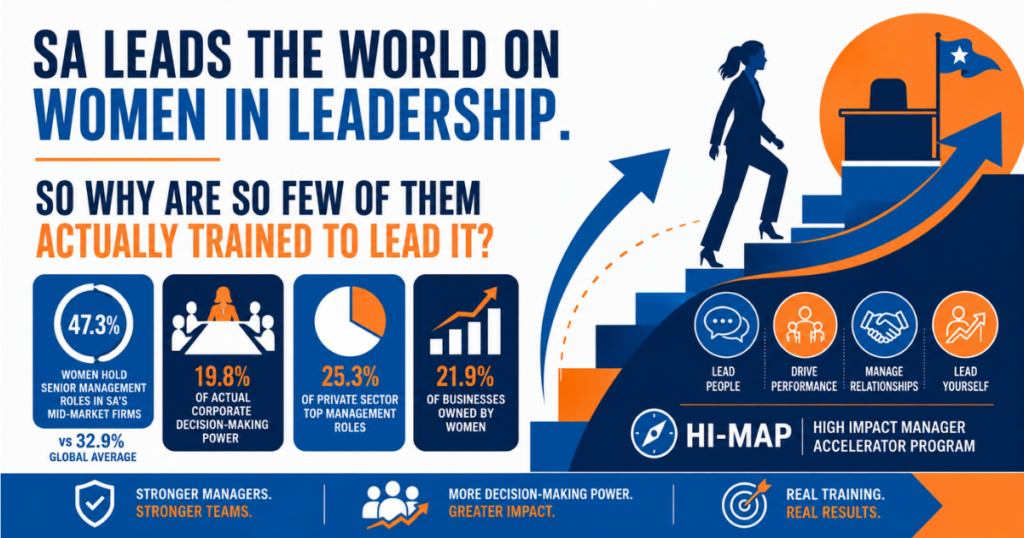
South Africa has genuinely good news to share on gender representation in business leadership, and it isn’t a caveat-heavy “good news, but” story. According to SNG Grant Thornton’s Women in Business 2026 report, women hold 47.3% of senior management roles in South Africa’s mid-market firms. That’s not marginally better than the rest of the world, it obliterates the global average of 32.9%. South Africa was also one of only a handful of countries in the entire study where not a single surveyed business reported an all-male senior management team.
We should be proud of that. Genuinely. It took decades of pressure, policy and plenty of individual women simply refusing to accept the ceiling, to get here. If you stopped reading at this paragraph, you’d walk away thinking South Africa has cracked it.
We haven’t. And the same research that hands us that headline also hands us the reason why.
The Number We Conveniently Leave Out
Representation and power are not the same thing, and South African business has a habit of confusing the two. Dig one layer deeper than the senior management stat and the picture changes fast. Research on JSE-listed and private sector companies puts women’s share of private sector top management at roughly 25.3%, with women occupying board seats at closer to 38% and executive committee seats at around 31%.
Separate analysis on decision-making authority, not just job titles, found that female executives in South Africa hold on average just 19.8% of actual corporate decision-making power, even where headcount representation looks strong. Read that again. Nearly half the senior management seats. Under a fifth of the actual power to decide anything. Somewhere between the appointment letter and the boardroom table, something is going missing, and it isn’t ambition.
Add ownership into the mix and the gap widens further. Women own roughly 21.9% of businesses in South Africa, marginally below the global average, and that figure has barely shifted in years despite all the policy attention pointed at it. So we’ve built a country that is genuinely excellent at putting women in the room. We have not built a country that is equally good at equipping them once they’re there, or at handing them the authority the title implies.
This Isn’t Really About Gender. That’s What Makes It Worse
The uncomfortable twist… The training gap sitting underneath these numbers isn’t actually a women’s problem. It’s a South African management problem that happens to land hardest on women because they were promoted into it faster and in greater numbers than almost anywhere else in the world, without the infrastructure to match.
Most managers in this country, regardless of gender, were promoted for one reason: they were excellent at the job they used to do. Best salesperson becomes sales manager. Best technician becomes ops manager. Best accountant becomes financial manager. Nobody asked whether they could actually manage people, run a difficult conversation, hold someone accountable without becoming either a tyrant or a doormat, or read what actually drives the person sitting across the desk from them. We just assumed competence in the old job would transfer to leadership in the new one. It rarely does on its own.
South Africa promoted women into senior management faster than almost any country on earth. That’s the achievement. But we promoted them into the same untrained, sink-or-swim management culture that everyone else gets promoted into, and then we act surprised when the decision-making power doesn’t follow the title. You cannot hand someone a seat and skip the seatbelt, then blame them when the ride gets rough. And this is where owner-managed businesses carry a particular blind spot.
Large corporates at least have HR departments running formal leadership pipelines, even if those pipelines are patchy. The privately owned, family run businesses that make up the bulk of the South African economy usually have none of that. Promotions happen on gut feel, on loyalty, on “she’s been here the longest so it’s her turn”.
There’s no structured onboarding into leadership, no assessment of how the person actually operates under pressure, and no budget line for developing them once the title has changed. The Business Owner is too busy running the business to build the management bench underneath them, and the new manager is left to work it out on the job, in real time, with real consequences for the team reporting to her.
Where HI-MAP Actually Fits In
This is precisely the gap The Alternative Board built HI-MAP, the High Impact Manager Accelerator Program, to close. Not as a Women’s Day gesture. As a genuine answer to the question every business eventually has to face: we promoted this person, now what do we do to make sure the promotion actually works?
HI-MAP starts in a place most management training skips entirely. Before anyone touches a single management technique, every participant completes a session on Understanding Behavioural Styles and Driving Forces, alongside their own DISC and Driving Forces assessment. That sounds like a soft add-on. It isn’t. It’s the difference between a manager who barks the same instruction at every employee and wonders why half of them switch off, and a manager who knows that the person who needs a clear deadline is not the person who needs to be asked for their opinion first. You cannot lead people you don’t understand, and most new managers have never been taught how to read the room, let alone how to read the individual.
From there, HI-MAP runs across four core Paths that a Business Owner or Leader can take individually, mix, or run as a full programme, covering the practical and interpersonal skills that separate a manager who merely supervises from one who genuinely leads.
It’s delivered by implementers who are leadership practitioners with real operating experience, not theorists reading from a slide deck, and it’s built around one blunt commercial reality: replacing a manager who fails is expensive, and the businesses that invest properly in developing the ones they’ve already got are the businesses that keep them.
That last point matters more than most Business Owners want to admit. Every Business Owner in South Africa knows what it costs to lose a good manager: the recruitment fees, the notice period where productivity quietly tanks, the months it takes a replacement to get up to speed, the institutional knowledge that walks out the door and never comes back. Training the manager you already trust is nearly always cheaper than replacing the one you didn’t.
It also changes what “decision-making power” actually looks like day to day. Power isn’t only granted from above in a title or an org chart position, it’s built from below through competence that a team learns to trust. A manager who has been taught how to run a hard conversation, how to hold a non-performer accountable without either avoiding the issue or torching the relationship, and how to read what genuinely motivates each person on her team, earns authority that no appointment letter can hand her. That’s the part representation statistics can never capture, and it’s exactly the part training is built to deliver.
The Real Test of Women’s Day Isn’t Yesterday
Anyone can post a tribute on a public holiday. It costs nothing and it changes nothing. The real test of whether a business genuinely values the women it has promoted is what happens on the Tuesday after, when the holiday is over and the only thing standing between a promotion and a resignation letter is whether that person was ever actually equipped to do the job you gave them.
The provocation… and it applies whether the manager you’re thinking of right now is a woman or a man: you handed someone a title. Did you hand them the tools? If the honest answer is no, the 47.3% number stops being something to be proud of and starts being something to be nervous about, because a seat without the skills or the authority to match it isn’t progress. It’s a promotion set up to fail quietly, one frustrated resignation at a time.
Yesterday was for the tribute. Today is for the accountability. If your business genuinely wants to be part of the number South Africa should be proud of, not just the number underneath it, the place to start isn’t another Women’s Day post next August. It’s a proper look at how your managers, all of them, got their training, and whether HI-MAP is the piece that’s been missing.
#Leadership #Coaching #BusinessBuildersAdvantage #TheAlternativeBoard #PeerAdvisoryBoards